The saga of General Shimoda’s fatal crash is unusual in that wreckage from the crash was discovered years after the war’s end and transported to a museum in Bangkok where it was placed on display until 2012. In that year, the museum was closed and the wreckage simply disappeared. Thansawath Saranyathadawong research on General Shimoda’s crash is detailed below, and it is hoped that someone can point to the present location of the wreckage so that it may be studied, and put back on display.
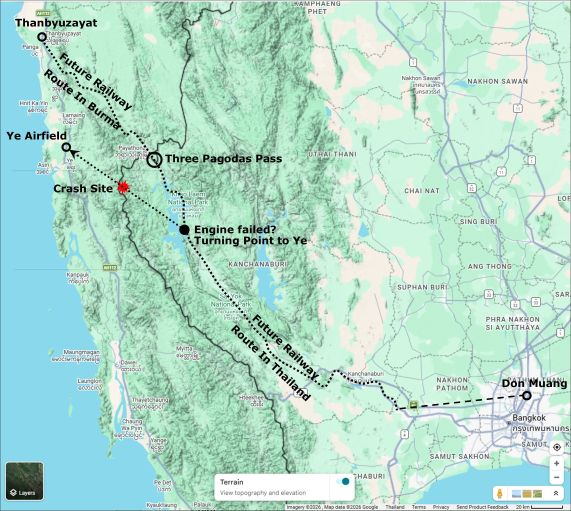 26 January 1943:1 Lieutenant General Shimoda Nobuo (offsite link to text in Thai)2 had only recently been assigned as commander of the Japanese Army authority overseeing construction of the Thailand-Burma Railway. In that capacity, he undertook an aerial survey of the route with his immediate staff, flying in a twin-engined aircraft from Don Muang Airfield3 (Google Maps link) near Bangkok to Kanchanaburi4 (Google Maps link) and on to Thanbyuzayat5 (Google Maps link) in Burma and back. During the flight back from Thanbyuzayat, the aircraft lost power in one engine forcing the pilot to seek out the nearest airfield which was at Ye6 (Google Maps link) in Burma, about 65 km to the northwest. Flying towards Ye, the aircraft, with only one engine functioning, did not have enough power to respond quickly to clear even relatively low lying obstacles. As a result, one wing clipped the top of a tall tree, the plane crashed, and nine of the eleven people aboard were killed essentially instantly. A tenth died soon after, leaving only one, Sakurai, variously identified as pilot or navigator, to tough it out in the surrounding jungle until discovered quite by chance nearly a month later.
Thansawath Saranyathadawong has done almost all the research on this subject and his comprehensive presentation in Thai on Facebook from 2021 follows in English translation, with subsequent details which emerged after his initial presentation enclosed in brackets:
_____________
THANSAWATH SARANYATHADAWONG’S FACEBOOK PRESENTATION (offsite link, with text in Thai)7
This is a report on the search for the wreckage of a Japanese military commander’s plane that crashed in the forest of Kanchanaburi Province during World War II, along with a timeline of the search from the initial findings to the latest updates.
The first commander of the Japanese Second Railway Construction Directorate, which oversaw the construction of the Thai-Burma railway, was Major General Shimoda Nobuo (下田宣力). While some documents refer to him as Shimoda Senriki, his correct name was Shimoda Nobuo.
On 26 January 1943, General Shimoda’s entourage boarded a bomber (identified as a medium bomber in the book, Across the Three Pagodas Pass8 ) to survey the progress on construction of the Death Railway. It is believed the plane flew from Don Mueang to inspect the future railway line all the way to its connection at the existing railway system in Burma at Thanbyuzayat.
 The aircraft was en route back to Bangkok, when, flying along the Thai-Myanmar border, the aircraft lost contact.9
Once Japanese authorities were certain that something had happened to the aircraft, the Japanese railway system dispatched several search and rescue teams into the forested area. After more than three weeks, nothing was found.
On 23 February 1943, one search team found the survivor, a soldier who had been the pilot of the aircraft [some sources identified him as the navigator]. He was found in the forest not far from Sangkhla. The book The Thailand-Burma Railway 1942-194610 states that he was found in Sangkhla, but other documents do not mention the exact location.
The survivor, Sakurai by name (The book Across the Three Pagodas Pass lists his name as Sakurai, while Lieutenant General Aketo Nakamura’s memoirs11 state that he could not recall the soldier’s name), had survived by foraging for wild food and drinking from streams, during his month in the forest. When Sakurai was found, he was suffering from injuries and severely exhaustion.
After the search team questioned Sakurai, he was returned to Bangkok, where he recounted the events of the crash to General Nakamura, the Japanese Commander-in-Chief of the Armed Forces in Thailand. He explained:
The aircraft had a total of 11 people on board, including crew and passengers.12 They were conducting an aerial survey of the Thai-Burma railway route. While returning from inspecting the route on the Burmese side, one of the engines malfunctioned near the border, forcing the aircraft to continue on powered by only one engine.
The pilot decided to land at the nearest airfield which was at Ye, Burma, about 65 kilometers off to the northwest [Alternatives were the origin of the flight, Don Muang, about 260 km ESE; and a possible air facility at Kanchanaburi at that time, about 150 km southeast. A bee-line to Ye required crossing over the mountain ridge of Khao (Mt) Mayan Tong which at some points was more than 1100 m high. Note that continuing down the future railway route to Kanchanaburi or on to Don Muang would have avoided such altitudes.]
During the flight to Ye Airfield, one of the plane’s wings struck a tall tree in the forest, causing the plane to crash (the single engine couldn’t lift the plane quickly enough to avoid hitting it.)
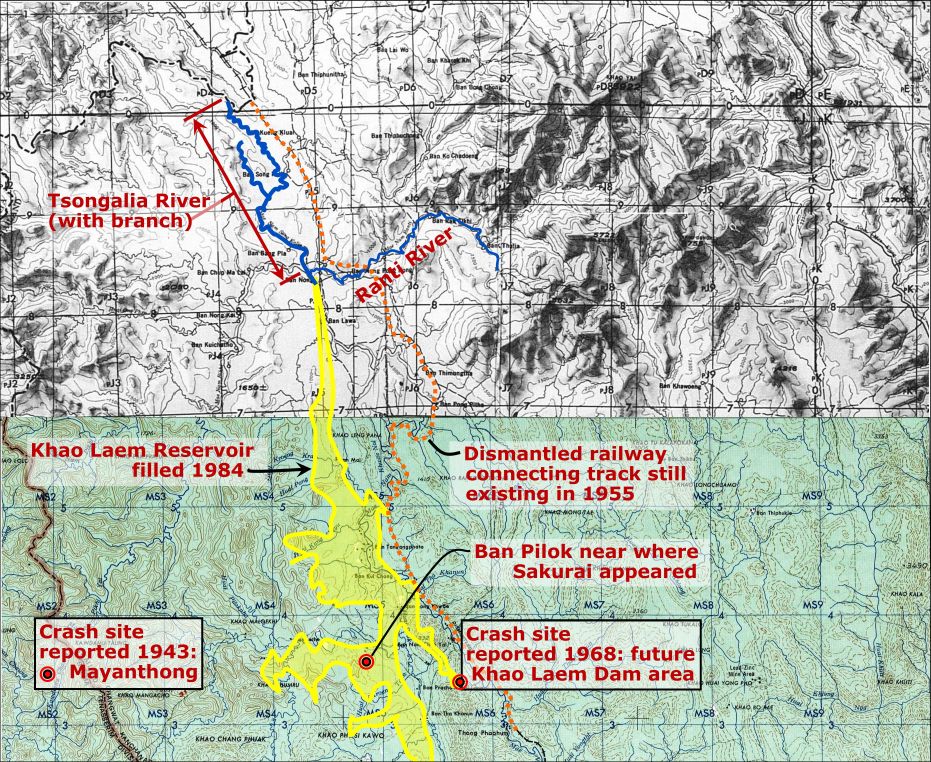
The location where the plane crashed is in the Khao Mayan Tong area13 (Google Maps link), which is on the Thai-Burmese border.14
The impact and explosion instantly killed nine crew and passengers, among them Major General Shimoda and his staff officer, Major Irei. Two survived: Sakurai recounted how, the plane wing hit a tree, jerking the plane violenty, and threw him from the aircraft, to crash into a large tree branch before landing on the ground without serious injury. After hitting the tree, the plane crashed, exploded, and burst into flames. A second soldier fell from the burning plane, but he was severely injured with burns all over his body.
Sakurai attempted to carry the soldier out of the forest to seek help, but they didn’t get far before dusk. The roar of a tiger echoed through the forest not far from them. The wounded soldier then told Sakurai to leave him there, saying he would become food for the tiger, distracting it, and allowing Sakurai to escape from the area.
Sakurai himself left the spot as his fellow soldier had instructed, but he felt immense guilt. When he came across a small stream in the forest, he realized he couldn’t go on any further and felt destined to die, so he waited for death by the stream. Nonetheless, he believed that, as a Buddhist, in Thailand a Buddhist country, a Bodhisattva15 might come to save him.
On 23 February 1943 (as stated in the book Across the Three Pagodas Pass), after nearly a month of unsuccessfully searching for the crash site, the search team was about to cancel its mission, when suddenly, a monitor lizard bolted from the forest. One of the team shot at it and the sound of the gunshot was loud enough for Sakurai, who was sleeping nearby, to hear. A moment later, the search team heard Sakurai’s shouts and hurriedly tracked down his voice to find the survivor living in a rocky crevice beside a small waterfall.
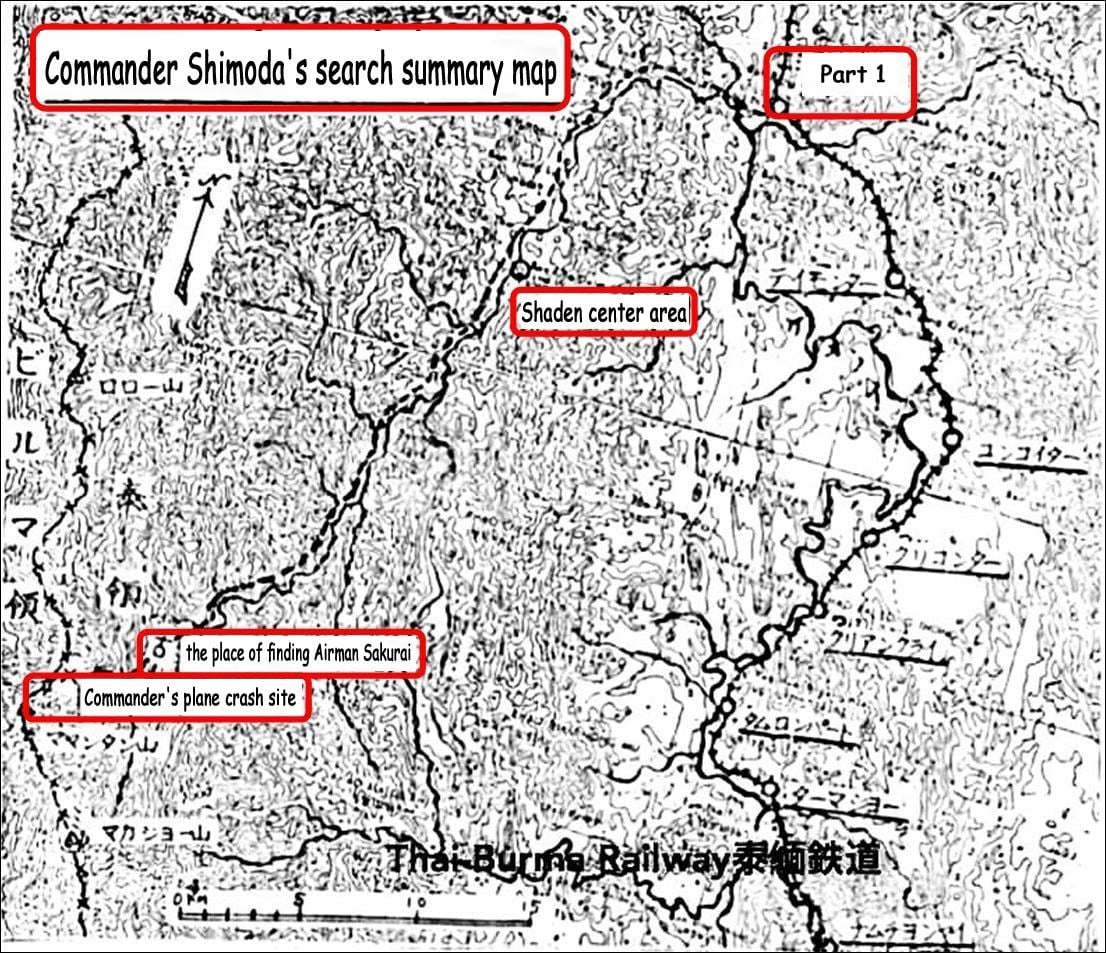
Sakurai told the search team where to find the crash site. Following his directions, they found the wreckage of the plane, which had been almost completely destroyed by fire, with only a metal plate displaying a general’s rank insignia and a twisted samurai sword, distorted by the violent impact of the crash, remaining. A map in the team’s report recorded the location of the crash (translated):16
Major General Nobuo Shimoda had been acquainted with Lieutenant General Aketo Nakamura. In fact, when Nakamura arrived in Thailand, he had waited at the airfield to meet Shimoda on his expected return that evening of 26 January 1943. However, Nakamura instead receiving the bad news that Shimoda’s aircraft had disappeared in the jungle on the Thai-Burmese border.
[While not listed in Royal Thai Air Force histories published in 1982 and 2021, Thansawath found in Thai Armed Forces Archives a report dated 08 April 1943 telling of the discovery of the wreckage of Shimoda’s aircraft on 23 Feb 1943 (Thansawath email 09:46 08 Jun 2022: 1651029041238.txt):
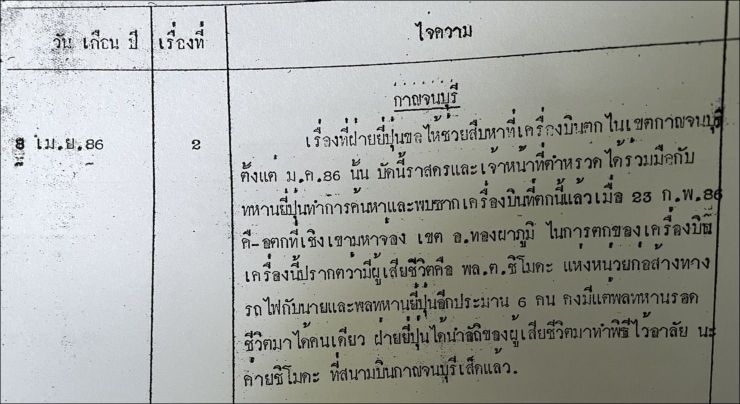 [Log entry] 08 Apr 1943
Kanchanaburi
Regarding the request from the Japanese side to assist in investigating a plane crash in Kanchanaburi province in January 1943, the Royal Thai Police and other officials have worked with Japanese search teams which found the plane crash site on 23 February 1943 at the foot of Khao Mayan Tong mountain in Thong Pa Phum District. One of those killed in the crash was General Shimoda. The plane had one officer and about six other Japanese soldiers. Only one person survived. The Japanese took the remains of the deceased to hold a memorial service.
While the record is unaccurate, the Thai government was aware of the event and apparently participated in the search.]
Nakamura’s records indicate that the body of Shimoda could not be recovered (it may have been either completely destroyed or its remains scattered; there is no information on this). Now, more than 80 years later, it is even less likely that any identifiable remains have survived in the tropical forest setting of the crash site.
Nakamura’s notes also state that he spoke with Sakurai (who at times wept in sorrow for his fellow soldier’s sacrifice). Nakamura recorded all this in his notebook, but the notebook was confiscated by Allied forces, and unfortunately, he himself could not remember the surviving soldier’s name (The name I obtained comes from the book Across the Three Pagodas Pass).
Major General Takasaki Sukemasa [Tsugemasa?], stationed in Manchuria during the war with China, succeeded Major General Shimoda as commander of the 2nd Railway Construction Directorate.
After being stationed in Thailand to oversee the railway construction, Takasaki fell ill with malaria in August 1943 and eventually died. Major General Ishida Eiguma succeeded him as commander of the 2nd Railway Construction Directorate and eventually participated in the opening ceremony of the Death Railway. He also initiated construction of the Thai Memorial Monument in Kanchanaburi Province to commemorate those who died in the construction of this railway.
At the opening ceremony of the Thai Memorial Monument, Major General Ishida Ekuma delivered a eulogy. The text states that during the arduous construction of the railway, they had lost two high-ranking commanders, Generals Shimoda and Takasaki, as well as over 1,000 Japanese soldiers and a large number of Asian prisoners of war and laborers.
Years later, reports indicated that plane wreckage had been rediscovered near the Khao Laem Dam17 (Google Maps link; aka, Vajiralongkorn Dam). The wreckage was recovered and placed in the Thai Railways Hall of Fame.
I’ve been trying to find information about this for many years. Let me give you a rough timeline of the discoveries.
This airplane was found near Ban Pa Hamak (this village no longer exists), on the eastern side of Khao Mayan Tong peak. The location is deep in the forest. Khun Jinda, a close associate of Royal Thai Army Lieutenant General Charn Angsuchoti living in Kanchanaburi, first heard of villagers around 1986-1987 telling of a Japanese soldier who had survived the crash. He had traveled near Ban Pilok Khi18 (Google Maps link) [not the current Pilok mine which is about 16 km south, but rather near the western bank of the reservoir, about 20 km west of the dam] and villagers had accompanied the soldier and search team to the crash site.
General Charn, informed of the wreckage and recognizing its historical significance, had wanted to preserve it, so he asked Jinda to retrieve it. Coincidentally, at that time, there had been a logging concession in the area, and a road had been built for logging trucks to transport the wood out of the forest. Chinda was able to use this road to transport the airplane wreckage out.
When Jinda went there, he said that all the samurai swords and guns had been collected by the villagers, the village headman, and the sub-district chief (I understand they’ve probably all been sold by now).
Upon arriving at the crash site, Jinda found wreckage widely scattered over the area. He also mentioned that there had been a large tree nearby, but with its top missing, possibly caused by the plane’s wing or an engine colliding with it. (This aligns nicely with Nakamura’s book, which states that the plane’s wing had struck the tree, causing the crash. However, Jinda said he didn’t know if the tree still existed today because logging concessions might have been cut it down. )
The earliest and most vivid memory Chinda has of the wreckage is the Japanese red sun symbol, still bright red, painted on the wreckage of the plane [see photo of wing below].
The plane wreckage was transported to the home of General Charn in Kanchanaburi town. I spoke with P’Paek, his nephew, who confirmed that the wreckage had indeed been brought to Charn’s house.
[Photos of the wreckage collected at General Charn’s house (Originally supplied by Sakpinit Promthep email of 01:19 01 Sep 2020; photos dated 02 Oct 1990). The person prominent in all the photos was Group Captain Veerayuth Didyasarin, founder of The Foundation to Preserve and Development of Thai Aircraft which is also known as “Tango Squadron” and The Tango Air Museum in Wing 41 at Chiang Mai Airport is a part of that foundation. An interesting confusion of names: Veerayuth’s nickname was “Tang” and the phonetic alphabet word for “T” is “Tango”, and that is the first letter of Thailand. At the start of this foundation, Veerayuth tried to collect as many aircraft as possible including wrecks and relics. The wreckage pictured here had been recovered by someone else so he was just inspecting it (Thansawath verified that the photos had been taken at the general’s house, per discussion with P’Paek, the general’s nephew (email 14:41 13 Jun 2022):19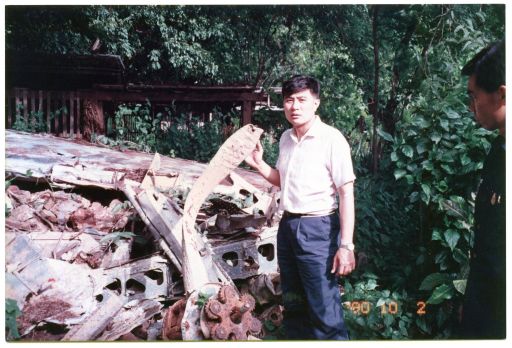
19901002-01.jpg
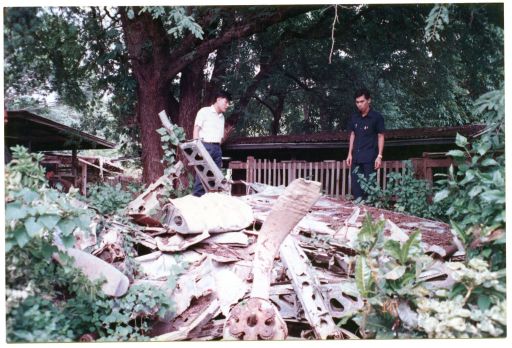
19901002-02.jpg
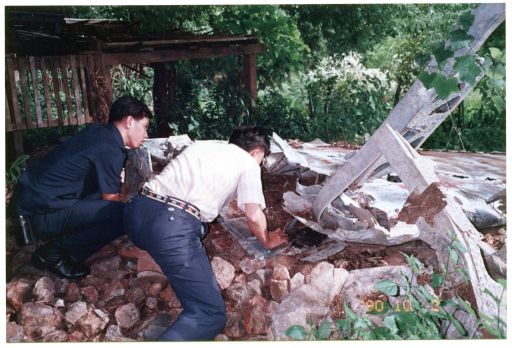
19901002-03.jpg
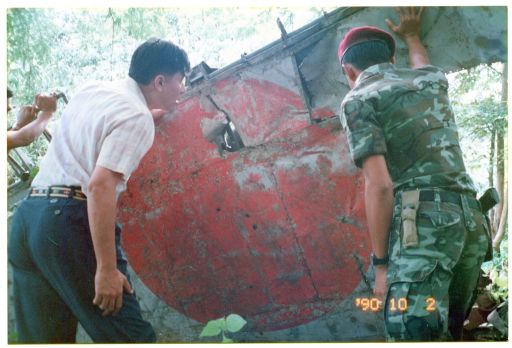
19901002-04.jpg
Soon after, Veerayuth recovered the wreckage of McGarry’s P-40 from the forest in Mae Hong Son.]
And how did the airplane wreckage end up at the Thai Railway Hall of Fame20 (Google Maps link)?21
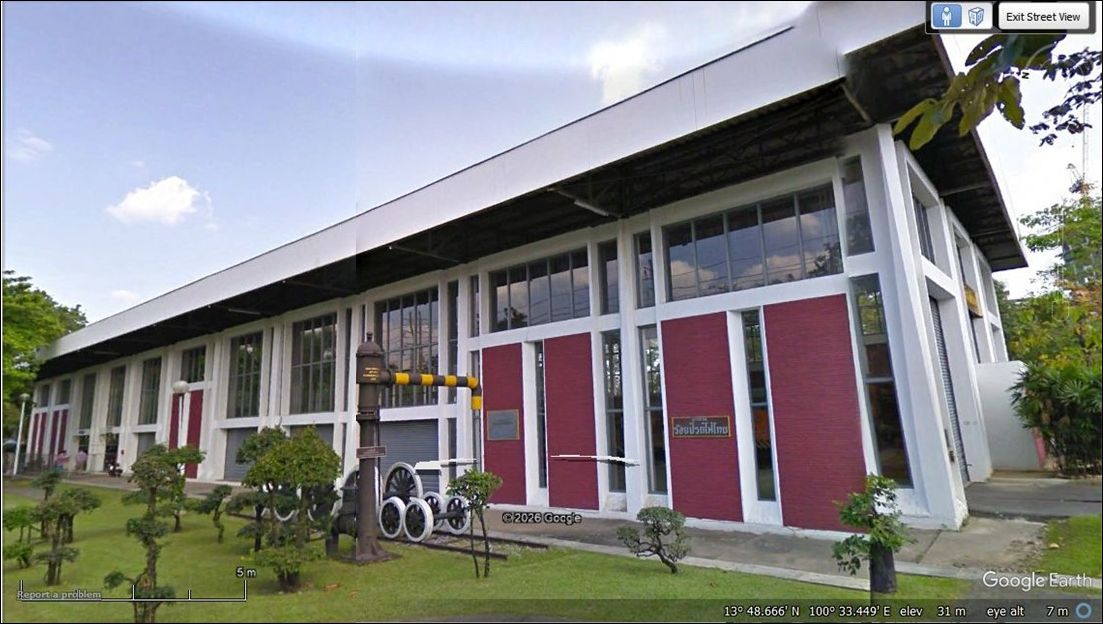 I had the opportunity to speak with Professor Rakkiat Lertsutsakul. He mentioned that he, along with Dr Sarppasiri Viriyosiri, had founded the “We Love Thai Railways” club and that they had requested permission to use a building in Chatuchak Park to store locomotives and all other items related to Thai railways.
The Professor also mentioned that he and Dr Saraphasiri had had the opportunity to speak with General Charn and requested permission to display the wreckage of this aircraft at the Thai Railway Hall of Fame for the public to see. General Charn had agreed, donating the aircraft wreckage to the museum, where it was displayed until 2012, when the Railway Hall was closed, and many items were removed from the premises.
I called the railway official in charge of the area, and he said that before the hall was closed, the individual caretaker had moved just about everything out, leaving only two locomotives and low-profile carriages. No aircraft wreckage had been left in the building.
I contacted the former caretaker to inquire about the location of the aircraft wreckage, as I was very interested in the subject and wanted to visit it for study. The caretaker replied that he did not know the location because the Thai Railways Museum has been closed since 2012.
Right now it’s still very much a mystery. I don’t know where the wreckage is. I only hope that it has been somewhere preserved, for eventual return for Thai people to see, as intended by Lieutenant General Charn Angsuchoti, whose team had retrieved it from the forest for the Thai people.
I’m 85-90% comfortable with the idea that this wreckage belonged to the Shimoda aircraft; but some information remains questionable:
I would like expert analysis regarding the model of this aircraft and whether it could actually carry 11 people. Some experts have identified it as a Ki-48 (offsite link). However, others have suggested a Ki-21 (offsite link), or a Ki-57 (offsite link), although I can’t rule out any other possibilities that might be offered.
Most agree that a Ki-48 is too small to carry 11 people, including pilot and crew. That’s the first point that raises doubts about whether a genuine Ki-48 model can actually carry the number of passengers stated in the documents.
Secondly, the book Across the Three Pagodas Pass is the only one that states that the Shimoda aircraft was a medium bomber, or a medium bomber converted for transport purposes. [Wikipedia lists no IJAAF medium bombers in World War II22] Other websites say that the Ki-48 was a light bomber (offsite link).
Some experts say it’s possible that a bomber could have been converted for use as transport aircraft during the war.
[Some earlier models of the Ki-21 were converted to transport functions; see Wikipedia: Ki-21 Operational History (offsite link):
A number of Ki-21-Ia were modified to serve as military transports for use by Greater Japan Airways, which was under contract by the Japanese Army in China for transportation. Designated “MC-21“, these aircraft had all armament and military equipment removed. Used primarily as cargo transports, each could also seat nine paratroopers.
Unfortunately no photos of a modified Ki-21 seem to be available.]
In any case, I have not found any document or book that specifically identifies the model of General Shimoda’s aircraft, and it is possible that the book Across the Three Pagodas Pass contains a translation error regarding the type of aircraft, as translations of Japanese into English can contain a fair number of errors. Furthermore, the author’s memory may have been inaccurate (which is suggested in the book). [For additional discussion about the identity of Shimoda’s plane, see separate section, “The Aircraft” below]
What makes me believe it is the wreckage of Shimoda’s aircraft is the detail about the plane crashing into a tree, which aligns with both the book and Jinda’s story.
Regarding the aircraft’s engines, one had failed before the crash. One wing was severely damaged from the impact. Several experts who have seen the engine and wing agree that one side was damaged, while the other engine was non-functional and one propeller blade was bent backward.
Then there’s the story of the one surviving Japanese soldier. Both the villagers’ accounts and the books match, but the discrepancy lies in the location where the survivor was found: villagers say he was found near Pilok, while Kratosky says he was found near Sangkhla.
The debate is ongoing, and all possibilities remain.
If anyone can help locate the wreckage of this plane, please let me know! I’ve been searching for it for years. I don’t want anything in return; I simply want to study it, share the story, and clarify history.
If anyone has any additional information to share, please feel free to contact me. We need to help each other. I can’t do this alone, so I’d like to ask for your help. Because if we don’t do anything now, it will be difficult to find information, including the wreckage of the plane, in the future, for it might disappear forever.
| First published on Internet | ||
Last Updated on 8 September 2026
- Google Maps extract annotated by author using Microsoft Publisher.
Future routes are traced from Wikipedia (offsite link).
Crash site is approximate, located on eastern slope of Mt Mayan Tong.
Engine failure point is approximate, located as an extension from crash site to Ye Airfield and assumes that Shimoda’s aircraft was following the Future Railway Route during his return from Thanbyuzayat. General map: my ref: \02500 Tango\_Crash sites N TH for Tango\DETAIL SHEETS\J430126 Kanchanaburi [J09C]\_jist\Jists.pub, sht 8[↩] - English translation of Thai article in Wikipedia:
Nobuo Shimoda (21 July 1891 – 26 January 1943) was an Imperial Japanese Army officer. His final rank was Lieutenant General.
Career
Born in Miyagi Prefecture, he graduated from the Army Academy on 28 May 1912, and was appointed Second Lieutenant in the Engineering Corps on 24 December 1912, assigned to the 4th Engineering Battalion. On 08 December 1915, he graduated from the Advanced Course of the Army Artillery and Engineering School and continued to study there as an adjunct student. On 20 April 1916, he was promoted to First Lieutenant in the Engineering Corps. On 10 July 1919, he graduated from the Department of Mechanical Engineering, Faculty of Engineering, Tokyo Imperial University.He was promoted to Captain of the Engineering Corps on 20 April 1921, then to Major on 24 March 1928. After serving as head of the Materials Depot of the 2nd Railway Regiment, he was promoted to Lieutenant Colonel on 08 August 1932. He was promoted to Colonel on 01 August 1936 after serving as an instructor at the Army Artillery and Engineering School, and became head of the Triangulation Section of the Land Survey Department.
He later served as commander of the 3rd Railway Regiment, and on 09 March 1939, he was promoted to Major General in the Army. He then became head of the Engineering Department at the Army Artillery and Engineering School. In 1940, he became head of the Land Survey Department and also served as the Second Railway Superintendent.
In January 1943, he was appointed construction manager for the Thai-Burma Railway, which had just begun construction. An aircraft he was on board conducting an aerial survey of the route suffered engine trouble and crashed in the mountains near the Thai – Myanmar border, killing him on 26 January. Although he died in the line of duty, he was treated as killed in action and after his death he was promoted to Lieutenant General and awarded the fourth rank of the Imperial Japanese Army.[↩]
- N13°54.72 E100°36.4[↩]
- N14°02.04 E99°31.53[↩]
- N15°57.12 E97°43.93[↩]
- N15°18.04 E97°51.84[↩]
- My ref: \02500 Tango\_Crash sites N TH for Tango\DETAIL SHEETS\J430126 Kanchanaburi [J09C]\Thansawath\20220601 1135 email FB\Facebook content.docx; also \02500 Tango\_Crash sites N TH for Tango\DETAIL SHEETS\J430126 Kanchanaburi [J09C]\Thansawath\20220601 1135 email FB\Facebook content-EMB.docx w photos[↩]
- Yoshihiko Futamatsu, Across the Three Pagodas Pass: The Story of the Thai-Burma Railway, (translated and introduced by Edward Escritt), edited and with a foreword by Peter N Davies (UK: Cambridge University Press, 2013) (Kindle, unpaginated) [↩]
- Composite map, my ref: \02500 Tango\_Crash sites N TH for Tango\DETAIL SHEETS\J430126 Kanchanaburi [J09C]\Maps\Shimoda\Shimoda crash.pub; sht 8: . . . \_jist\Maps\Shimoda crash2.jpg
Though undated, the upper map appears quite “old”, and shows Ban Nong rather than Sangkhla Buri (Google Maps link) (aka, Sangkhla, Songalia, Sonkurai, Tsongalia; and not to be confused with Songkhla in the extreme south of Thailand). It is extracted from US National Archives, “Overlay indexes for degree square 15N098E” (offsite link). Ban Nong / Sangkhla Buri (N15°08.56 E98°27.06) (Google Maps link) is located near the conjunction of the Tsongalia and Ranti Rivers.
Lower map is extracted from US Army Map “Tavoy ND 47-6 USA U542” (offsite link), printed in 1959.
Reservoir outline in yellow is traced from Google Earth.
Route correction over Ranti River added per Thansawath email 08:55 14 Jun 2022.[↩]
- Kratoska, Paul, The Thailand-Burma Railway, 1942-1946: Documents and Selected Writings (Oxfordshire: RoutledgeCurzon, 2005) [↩]
- เขียน เออิจิ มูราชิมา, อาเคโตะ นากามูระ, ผู้บัญชาการชาวพุทธบันทึกผู้บีญชาการ กองทัพญี่ปุีนประจำประเทสไทย เกี่ยวกับสงครามโลกครั้งที่ 2, นครินทร์ ดมฆไตรรัตน์ แปล (กรุงเทพฯ : มติชน, 2546) [Aketo Nakamura with Eiji Murashima, translated by Nakarin Domkhatrirat, Buddhist Commander General Nakamura Memories of Thailand During World War II (Bangkok: Matichon, 2003) ] [↩]
- the book, Across the Three Pagodas Pass, states 11 people; General Nakamura’s memoirs state “over ten”; and The Thailand-Burma Railway mentions 10 deaths and 1 survivor, totaling 11[↩]
- N14°50 E98°15[↩]
- All books agree that it crashed at Khao (Mt) Mayan Tong, or southwest of Three Pagodas Pass; however, only the book, The Thai Burma Railway 1942-1946, adds the detail that the plane crashed on the western side of Khao Mayan Tong, which would have put it in Burma.[↩]
- Practitioners taking the Bodhisattva Vow commit to putting noble qualities into practice across multiple lifetimes, venerating Buddhas, and placing themselves in the lifelong service of others.[↩]
- Provided by Thansawath email of 10:29 12 Jan 2024 and also 11.8 Shimoda Crash; translations by Wurger in ww2aircraft.net forum (offsite link); my ref: \02500 Tango\_Crash sites N TH for Tango\DETAIL SHEETS\J430126 Kanchanaburi [J09C]\_jist\Maps\Shimoda map xlatn.jpg[↩]
- N14°47.96 E98°35.82[↩]
- N14°49.22 E98°24.44[↩]
- The photos were provided by Sakpinit Promthep email of 01:19 01 Sep 2020[↩]
- หอเกียรติภูมิรถไฟไทย N13°48.66 E100°33.41[↩]
- \02500 Tango\_Crash sites N TH for Tango\DETAIL SHEETS\J430126 Kanchanaburi [J09C]\_jist\Jists.pub, sht 1: \02500 Tango\_Crash sites N TH for Tango\DETAIL SHEETS\J430126 Kanchanaburi [J09C]\_jist\Museum oblique1.jpg[↩]
- Source: Imperial Japanese Army Air Service (offsite link) [↩]