06 Aug 1944: 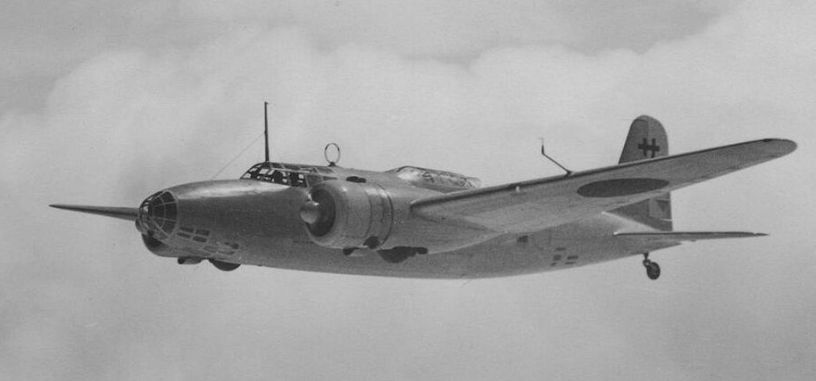 A Mitsubishi Ki-21 heavy bomber, No. 7/84, flying mail from Don Muang to Lom Sak, encountered a severe rainstorm and crashed into Nom Nang Mountain1 (Google Maps link), Phetchabun Province, killing all thirteen on board.
References:
- ประว้ติกองท้พอากาส ในสงครามมหาเอเชียบูรพา ระหว่าง พ.ศ.-๒๔๘๔-๒๔๘๘ (นครราชสีมา: สมบูรณ์การพิมพ์, พ.ศ.๒๕๖๔) [History of the Royal Thai Air Force during the Great East Asia War, 1941-1945 (Nakhon Ratchasima: Somboon Printing, 2021); hereafter, RTAF History 2021], p 220 (translated):
06 August 1944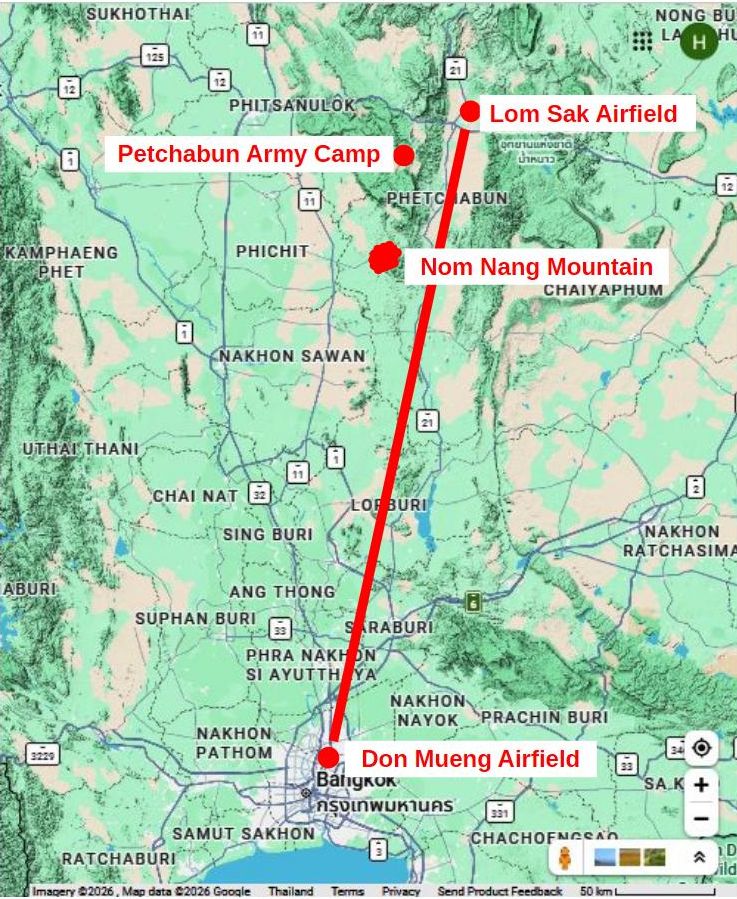
Time 1330 hrs. A Mitsubishi Ki-21 heavy bomber, No. 7/84, flying mail from Don Muang to Lom Sak, entered a rainstorm and crashed into Nom Nang Mountain1 (Google Maps link), Phetchabun Province, killing all thirteen crewmembers and passengers, per an incomplete list of crew and passengers:
-
-
- Cdr Kriangkrai Inkavanich, 62nd Squadron Commander
- Lt Cdr Prasit Chaiyo, 61st Squadron Commander
- Flt Lt Thongkhao Phasanon, Pilot
- Sub Lt Penrung Kasemsan, Co-pilot
- Pvt Boonrod, Mechanic
- Pvt Chamnong Thanrang, Flight Attendant
- Seven passengers, consisting of pilots of the 62nd Squadron (all Sub-Lt Flt Lts), financial officers, and non-commissioned officers.
-
-
- Lt Col Surin Chanthadang, Rear Gunner, Page 332-3372, offered a very personal recollection:
In just one night I had gotten what I wanted: five kilograms of wild betel leaf. I hid it in the bomb bay [before flying out from Lomsak Airfield3 (Google Maps link)]. When I arrived at Don Meung,4 (Google Maps link), I went to a merchant near the airport to ask if she was interested in buying it. She said she would take all of it: it weighed five and a half kilograms and, at eight baht per kilo, I got 44 baht total. If our boss had known about this I would have been in trouble. Next day I returned to Lomsak on the plane. Jamnong was waiting to pick me up and I gave him 30 baht [if accurate, a huge sum for a low-ranking soldier at the time]. When we were alone, I told him that the next time he would be buying the betel leaf, and it should be five kilograms, bought before the end of the month, and not to let anyone see what he was doing or else they might follow him.
On 5 August 1944 at 0730 hours, Nakajima 7 was scheduled for the Lomsak-Don Mueng flight. Jamnong prayed for the aircraft to be able to arrive at Don Meung without mishap since we had ten baskets of wild betel leaf in the bomb bay. As things had gone so smoothly, I helped spin the props to start Aircraft 7’s two engines. Usually the plane would overnight at Don Meung to fly back to Lomsak the next day.
On that next day, the sky in Petchabun was very cloudy from early morn until 1330 hours. After noon, rain began falling and it was falling heavily by 1430 hours. The rain kept us from working! I was trying to sleep, but it was impossible because two colleagues were arguing. That annoyed me, so I went to hear news about the flight at the Lomsak radio station. Arnon said the aircraft had left Don Meung at 1330 hours. By 1500 hours, it should have arrived [Lomsak to Don Mueng was about 330km and the cruising speed of the Ki-21 was 380 kph]. I was restless because I couldn’t do anything. At 1500 hours, the phone rang: the air security guard at Petchabun Army Camp (possibly present day Itthi Military Base5 (Google Maps link) ) reported that the air security guard on top of Chondaen mountain [Chondaen area6] (Google Maps link) had told him that he had seen a twin engined aircraft flying 400 meters above the peak of the mountain through dark clouds heading towards Nombang mountain; some minutes after that he had heard a very loud explosion — that must have been our Nakajima 7 which we had been waiting for. The communications officer sent an urgent memo to the Rescue and Investigation Unit. A patrol car and an army truck with twenty men went off to the site. I asked to join, but I was told to stay at Lomsak and help make coffins.
At the airport we made 10 coffins. I waited for two days for the team to come back: I was restless. They arrived at 1400 hours on 9 August 1944 and I ran to the truck. There was no one with injuries, just two long canvas bags and eleven small bags. Therefore, we had to make three more coffins. The head of the rescue team had decided to cut the bodies into five pieces each because it was impossible to carry whole bodies in rough wilderness area like that.
A funeral was held at Ban Sak Long School7 (Google Maps link). I asked a sergeant about Jamnong and he said that his body had been thrown clear of the aircraft, so it had not been burnt.
| First published on Internet | ||