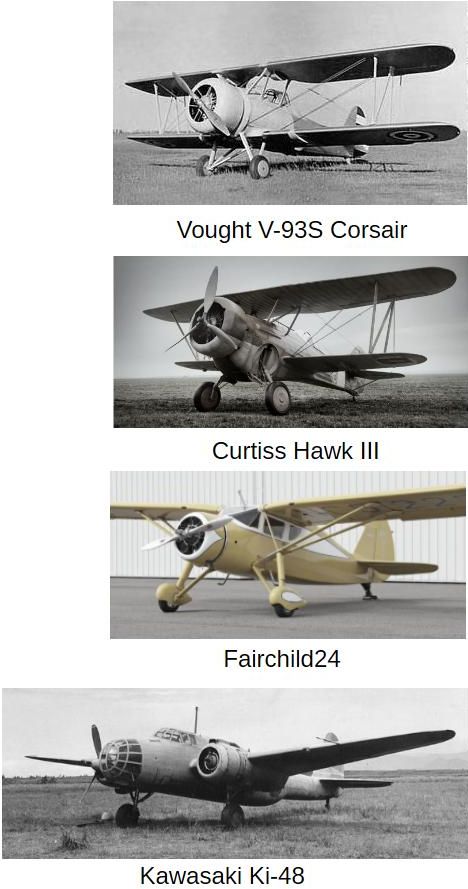
20 Nov 1943: 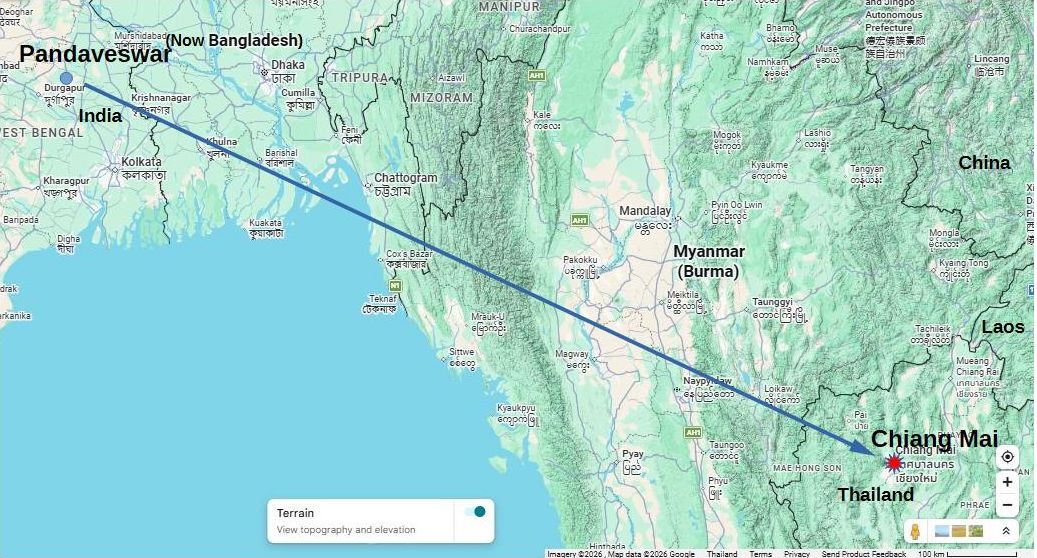 Allied B-24s bombed Chiangmai: Royal Thai Air Force lost 2 Curtiss Hawk IIIs and 2 Vought V-93S Corsairs (1 trainer, 1 attack) by fire. One Corsair was damaged by bomb debris. A Fairchild 24 of the Aerial Transport Company of Siam was destroyed by fire.1 A Japanese Army Air Force Kawasaki Ki-48 twin-engined light bomber was destroyed. Numerous ground facilities were also destroyed or damaged.2
References:
- ประว้ติกองท้พอากาส ในสงครามมหาเอเชียบูรพา ระหว่าง พ.ศ.-๒๔๘๔-๒๔๘๘ (นครราชสีมา: สมบูรณ์การพิมพ์, พ.ศ.๒๕๖๔) [History of the Royal Thai Air Force during the Great East Asia War, 1941-1945 (Nakhon Ratchasima: Somboon Printing, 2021)], pp 155-156 (translated):
20 November 1943
The USAAF 7th Bombardment Group [headquartered at Pandaveswar Airfield (Google Maps link) in West Bengal, India3] sent B-24 aircraft from four squadrons to bomb Chiang Mai and Lampang airfields:
-
-
- 9th Squadron (based at Pandaveswar Airfield),4 six aircraft assigned, one dropping out, leaving five.
- 436th Squadron (based at Panagarh Airfield (Google Maps link) ),5 seven aircraft assigned, two dropping out, leaving five.
- 492nd Squadron (based at Panagarh Airfield),6 seven aircraft assigned, two dropping out, leaving five; those five were diverted to alternate targets in Burma.
- 493rd Squadron (based at Pandaveswar Airfield),7 seven aircraft assigned, three dropping out, leaving three.
-
Time 1650 hrs. Eight aircraft from the 9th and 493rd Squadrons [the two squadrons located at Pandaveswar Airfield] dropped one-hundred forty 100-lb bombs from 18,000 feet on Chiang Mai Airfield, with the following results:
-
-
-
- RTAF: Three Thai Air Force personnel killed:
- Cpl Kham Sinsuk
- Pvt Peuan Ngamtip
- Pvt Leua Rittidet
One seriously injured, three less seriously.
- RTAF equipment, facilities destroyed:
- Two Curtiss Hawk III fighters (No. 42/82 and 45/82)
- One Vought Corsair trainer (No. 11/81) from the 52nd Squadron
- One Vought Corsair fighter from the 31st Squadron
Three hangars burned. Another Vought Corsair from the 23rd Squadron, two hangars, and one mechanic’s quarters damaged by shrapnel.
- Aerial Transport Company of Siam: one Fairchild 24 aircraft, along with hangar and equipment, destroyed by fire.
- Collateral damage: one person killed, four injured, and an abandoned temple and four houses burned with five more damaged.
- IJAAF: at least three soldiers killed, and one light bomber [a 34th Sentai Kawasaki Ki-48]8 and an aviation equipment warehouse destroyed by fire.
- RTAF: Three Thai Air Force personnel killed:
-
-
- Shores, et al, Air War for Burma (London: Grub Street, 2005). pp 113-114:
While discussing numerous air activities in the period 16-21 November 1943, Shores makes no mention of Chiang Mai.
- Edward Young, Aerial Nationalism (Washington: Smithsonian, 1995) p 201:
[1943] While RAF and USAAF long-range bombers concentrated on damaging the more distant Japanese communications network linking Bangkok with southern Burma, other Allied aircraft conducted a simultaneous campaign against the road and rail links throughout northern Thailand. . . . The Japanese had improved the rail facilities in the north and built a better road system into Burma. . . . The marshalling yards at Chiang Mai and Lampang became important targets, as did the nearby airfields, which the Japanese Army Air Force used as well as the Thais. Because its bases were closer to northern Thailand, the American 14th Air Force in China was heavily involved in these attacks. B-24s from the 308th Bomb Group made their first raid on November 20, 1943, hitting the airfields at Chiang Mai and Lampang.
Note that Young credits the 308th Bomb Group, whereas the RTAF History describes the 9th Bomb Group’s actions in detail (above). In his The Tenth Air Force in World War II (Atglen: Schiffer, 2020), pp 170ff, he does not cover this event, which was in a period heavily dominated by the resurgence of seasonal bombing of Rangoon.
- Hiroshi Umemoto, Air War in Burma, vol 1 (Tokyo: Dai Nippon, 2002) [梅本弘,ビルマ航空戦・上 (東京:大日本印刷株, 2002)] does not list this event.
- The Official Chronology of the USAAF in WW2 1943 (offsite link) and Eric Hammel, Air War Pacific Chronology (Kindle Edition, 1998): Curiously, considering the size of the operation and its results, the event is not listed in either publication.
Note that accounts of the concurrent attacks by the 436th Squadron on Lampang and by the 492 Squadron on alternate targets in Burma have not been found.
| First published on Internet | ||
Last Updated on 17 September 2026
- All the above was noted in Sakpinit Promthep email of 08:51 06 Feb 2021[↩]
- Map: Google Maps extract, annotated by author using LibreOffice Draw.
Photos:
Vought V-93S Corsair (offsite link)
Curtiss Hawk III (offsite link)
Fairchild 24 (offsite link)
Kawasaki Ki-48 (offsite link) [↩] - Pandaveswar Airfield (offsite link) [↩]
- 9th Squadron location: Pacific Wrecks (offsite link) [↩]
- 436th Squadron location: Pacific Wrecks (offsite link) [↩]
- 492nd Squadron location: Pacific Wrecks (offsite link) [↩]
- 493rd Squadron location: Pacific Wrecks (offsite link) [↩]
- On 05 Jun 1943, a Kawasaki Ki-48 twin-engined light bomber (Allied code name “Lily”), homebased at Chiang Mai with the 34th Sentai, had crashed on a final approach: it is here assumed that the 34th Sentai was still stationed there five months later. Shinpachi identified the aircraft and unit (ww2aircraft.net) (offsite link). Shores, et al, (3, p 426) placed the 34th Sentai in Chiang Mai from Oct 1942 to Feb 1944.[↩]