20 Mar 1945: 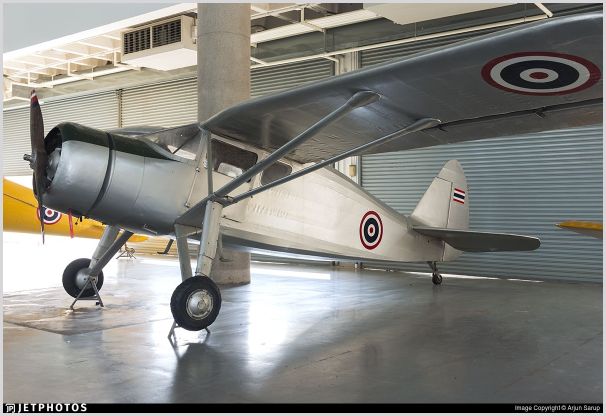 an Aerial Transport Co1 Fairchild 24J2 carrying Thai mail and three passengers was shot down by a USAAF P-51. The civilian pilot — a former RTAF pilot, Pui Pumsatit,3 and his three passengers were killed. The plane was flying from Mae Hong Son4 (offsite link) to Mae Sariang5 (offsite link) and crashed south of Mae Surin at a well-defined crash site6 (offsite link).
References:
- ประว้ติกองท้พอากาส ในสงครามมหาเอเชียบูรพา ระหว่าง พ.ศ.-๒๔๘๔-๒๔๘๘ (นครราชสีมา: สมบูรณ์การพิมพ์, พ.ศ.๒๕๖๔) [History of the Royal Thai Air Force during the Great East Asia War, 1941-1945 (Nakhon Ratchasima: Somboon Printing, 2021)], p 339 (translated):7
20 March 1945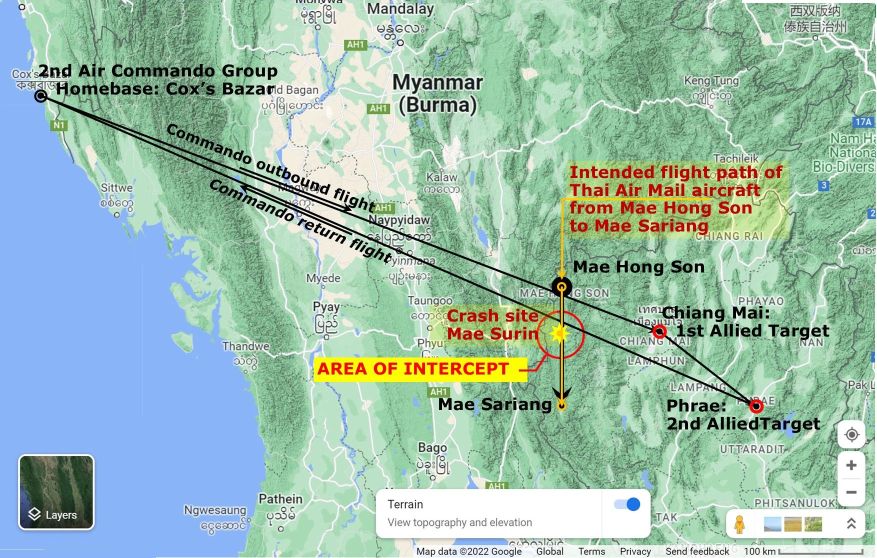
Time 1000-1120 hrs. Thirty-four USAAF 1st Fighter Squadron (Commando) P‑51Ds (six aircraft having dropped out), divided into forces to attack:
· Mae Hong Son
· Phrae
· Lamphun
· Fang Airfield (Wiang Airfield)
· Chiang Mai Airfield
Capt William C Marshal, piloting a P-51D, shot down a Transport Company Fairchild 24 aircraft, while it was flying on its Mae Hong Son-Chiang Mai commercial route. The plane crashed at Ban Mae Surin, killing Mr Pui Phumsathit, the pilot, and two passengers. Because it was the last remaining airplane of the company, the company was forced to cease operations.
- Young, Edward, Aerial Nationalism (Washington: Smithsonian, 1995), p 214-216:
Young, in describing the difficulties under which the Aerial Transport Co had to operate, wrote:
If the military aircraft situation was bad, civil aviation was worse. The Aerial Transport Company had been forced to curtail some services soon after the war started because of a shortage of equipment and serviceability problems. . . . The Company itself was finally forced to shut down all its operations in March 1945 when a P-51D Mustang of the Second Air Commando Group shot down its last serviceable aircraft, a Fairchild.
- Shores, Christopher, Air War for Burma (London: Grub Street, 2005), p 342:
Tuesday, 20 March 1945 . . .
On this date the fighter squadrons of the 2nd Air Commando Group flew to northern Thailand to strafe fields at Chiengmai and [Phrae], which were being used by the Japanese as air staging posts. Near Chiengmai Capt William C Marshall of the 1st Command Squadron encountered a small single-engined aircraft which he identified as a ‘Stinson-type’ and shot it down. It was in fact a civilian Fairchild 24 of the Aerial Transport Company of Thailand, which was unfortunate enough to have arrived at exactly the same time as the US fighters.
Mae Surin and Chiang Mai are separated by 110km and a couple of mountain ranges. Shores’ “near Chiengmai” might best be construed as in “the encounter occurred nearer to Chiang Mai than to Bangkok which is 800km distant”.
The 2nd Air Commando Group was homebased in Cox’s Bazar, then located in Bengal Province of British India.8
- Steve Darke/Ozel, Thai Air Accidents (offsite link), p 79:
- Date: Mar45
- Type: Fairchild 24
- Operator: Thai AF
- Serial: —
- Location & Details: Shot down by USAAF P-5
- Hammel, Eric. Air War Pacific Chronology (WWII US Air War Chronology) Pacifica Military History, Kindle Edition:
March 20, 1945 BURMA: Twenty Tenth Air Force P-47s sweep roads across central Burma; and 16 P-47s attack supply dumps. A 1st Air Commando Group P-47 downs a light liaison plane near Bkhun Yuam.
- Umemoto,9, a Japanese chronicler of the air war in the Burma area, does not record the event.
Site Visit
A one-time puyaiban (headman) of Ban Mae Surin, Junkhin Bradit, 83-years-old, knew exactly where the mail plane had crashed. Unfortunately, he was under doctor’s orders to minimize his walking because of gout.10
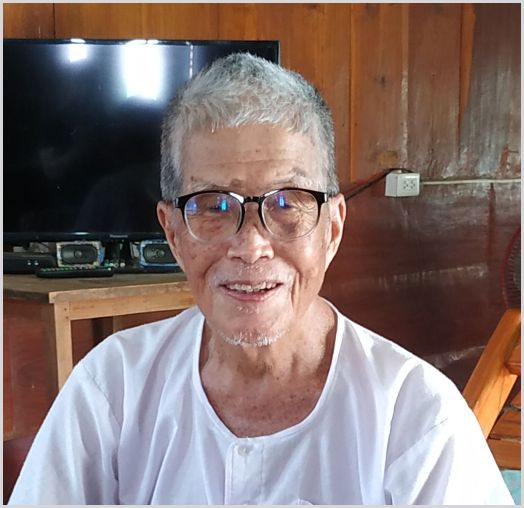 |
Mr Junkhin Bradit 66 Moo 3, Tambon Khun Yuam Amphoe Khun Yuam Mae Hong Son Province [N18°54.906 E97°56.674] |
นาย จันขิ่น ประดิษฐ์ 66 หมู่ 3 ตำบลขุนยวม อำเภอขุนยวม จังหวัดแม่ฮ่องสอน |
After some discussion, a daughter of Mr Junkhin, brought in See Duang-gaeo, a 73-year-old former assistant to Mr Junkhin. He also knew the location of the crash site since it was in a wood on the slope directly above his cornfield. He agreed to take us there.11
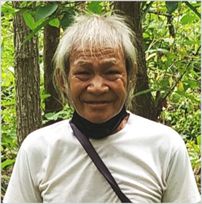 |
Mr See Duang-gaeo (House behind Ban Mae Surin Temple) Tambon Khun Yuam Amphoe Khun Yuam Mae Hong Son Province |
นาย ศรี ดวงแก้ว หลังวัดบ้านแม่สุริน ตำบลขุนยวม อำเภอขุนยวม จังหวัดแม่ฮ่องสอน |
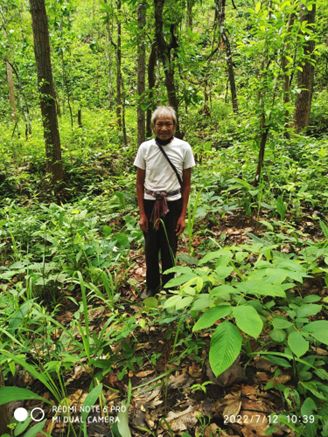
He directed us south onto Route 108 to cross the Mae Surin to the opposite (westerly) bank, turning right (northerly) into a badly rutted road through working rice paddies on the river plain, then westerly up to another level of paddy to park, continuing along a road on foot, dropping into a dry stream bed for a stretch, then up out of that into a steeply sloped field studded with large rocks which was his property for growing corn, though he hadn’t planted this year. And finally, into the more steeply sloped woodland bordering his field with Mr See bushwhacking a path for us through second growth trees, brush, ground vines, and crossing a deep cut stream bed where exposed roots served as steps, to the crash site. It was an anonymous section of woods, distinguishable only to Mr See (and Mr Junkhin) because of his familiarity with the woodland. Looking WNW at Mr See, with the crash site directly behind him:
 12
12
To Mr See’s credit, at 73, he was quite obviously comfortable with the climb, whereas I was just as obviously not — shades of the climb up Doi Farang, led by then 75-year-old: Boonyen Khantakrua — this hike up slope only took about 20 minutes and, unlike at Doi Farang, there was no rotten, delaminated, slippery, teetering rock. Thankfully.
The location as determined by the on-site visit,
plotted on Google Earth: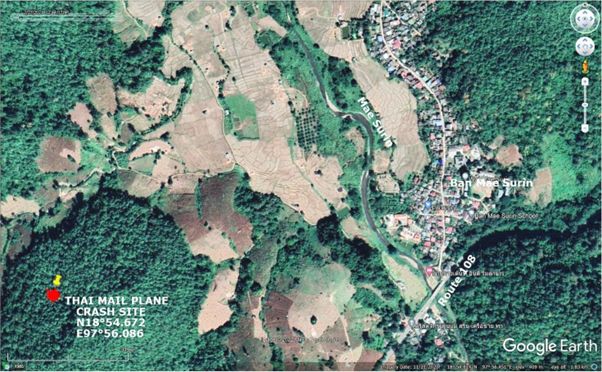
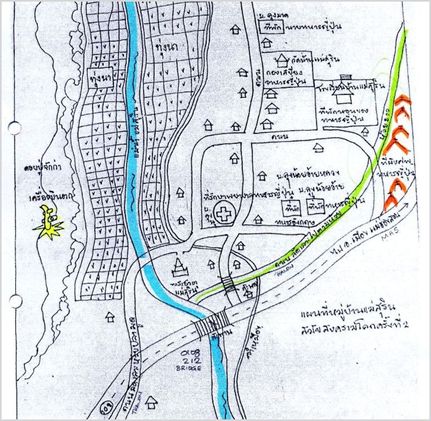
I first learned the location of this crash from retired Police Lt Colonel Cherdchay Chamtawat. This sketch is the only hardcopy information that he could provide me about the crash; he clarified that he had not tried to visit the site. The crash site is shown at far left, mid-page:13
Curiously, the Thai-Japan Friendship Memorial Hall in Khun Yuam does include this text on one wall display:

Transcription (with corrections, additions in brackets):
Parts of the aircraft shot down by the [Allies] at Baan Mae Surin in [1945]. [Casualties] included a Japanese officer, Police Captain Phan Antrikanon, Mae Hong Son Provincial Police Commander, Mr Pui [Pumsatit][7], the first pilot and an unknown second pilot.. All reported dead.
But, while the beginning text reads, “Parts of the aircraft”, there was in fact no display of any wreckage beneath the sign. Possibly it may be somewhere in the Memorial Hall storage. Note that this is the only text which describes a “second pilot” (co-pilot).
The Fairchild 24J, designed for the civilian market, was not the mine of highly valued aluminum that military aircraft crashes normally represented in Thailand. Thus, the wreckage near Mae Surin would not have been as attractive for scavengers as, say, the B-24 crash sites in Uttaradit Province, both of which also had the advantage of being located on relatively flat and very accessible ground. The following is a description for the Fairchild 24-W9 model which was built in 1939, the year following the production of the Fairchild 24J model for Thailand; note its single reference to aluminum:14
The main cabin area and the wing itself are made of wood. . . . Aft of the cabin the fuselage is made of square steel tube, except for the empennage [tail assembly], which is round steel tube. Wood formers are used to shape the fabric covering of the steel fuselage structure. For all of the wood, fabric, and steel in the airplane, the ailerons are aluminum.
Cherdchay Chamtawat
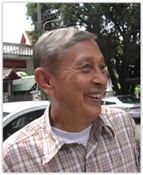 Cherdchay Chamtawat15 was a Police Lt Colonel stationed at Khun Yuam as Deputy Superintendent to the Chief of Amphoe Khun Yuam from 1995 to his retirement (sometime after 2004). He took it upon himself to record reminiscences of local Thai residents about events in Khun Yuam during World War II and to collect artifacts of the period from various sources. These formed the nucleus for what eventually became the Thai-Japan Friendship Memorial Hall in Khun Yuam. He was instrumental in getting interested Japanese to provide financial support for the project and made at least one trip to Japan in that effort. In the process, he became a close friend of Inoue Motoyoshi, an IJA veterinarian who had passed through Khun Yuam near or after the end of the war, and who hosted Cherdchay’s visit to Japan.
| First published on Internet | ||
Last Updated on 17 September 2026
- Company confirmed as owner per Sakpinit Promthep email of 0100 18 Aug 2020.[↩]
- Photo: B.S1-7/94 (offsite link) by Arjun Sarup[↩]
- Sakpinit email, ibid[↩]
- N19°18.24 E97°57.91[↩]
- N18°10.91 E97°55.85[↩]
- N18°54.672 E97°56.086[↩]
- Map: extract from Google Maps, annotated by author using Microsoft Publisher.[↩]
- Maurer, Maurer, Combat Squadrons of the Air Force World War II (Simpson Historical Research Center & Office of US Air Force History, 1982) (pp 14-15) [↩]
- 梅本弘,ビルマ航空戦 (東京:大日本印刷株, 2002) [Umemoto, Hiroshi, Air War in Burma, vol 2 (Tokyo: Dai Nippon, 2002)][↩]
- Photo: part \02500 Tango\_Crash sites N TH for Tango\DETAIL SHEETS\T450320 Mae Surin [T15]\Visit 20220712\Original photos\IMG_20220711_154055pt.jpg, by author.[↩]
- Photo: my ref, part \02500 Tango\_Crash sites N TH for Tango\DETAIL SHEETS\T450320 Mae Surin [T15]\Visit 20220712\Original photos\IMG_20220712_103942.jpg, by author[↩]
- Photo: my ref \02500 Tango\_Crash sites N TH for Tango\DETAIL SHEETS\T450320 Mae Surin [T15]\Visit 20220712\Original photos\IMG_20220712_103942.jpg, by author[↩]
- my ref: \02500 Tango\_Crash sites N TH for Tango\DETAIL SHEETS\T450320 Mae Surin [T15]\Backgnd\Mae Surin sketch.jpg[↩]
- “Fairchild 24 Grande Dame of Aviation” (offsite link), AOPA, 05 Aug 2000[↩]
- Photo source: frame from untitled video from Japanese TV dated 11 Dec 2007.[↩]