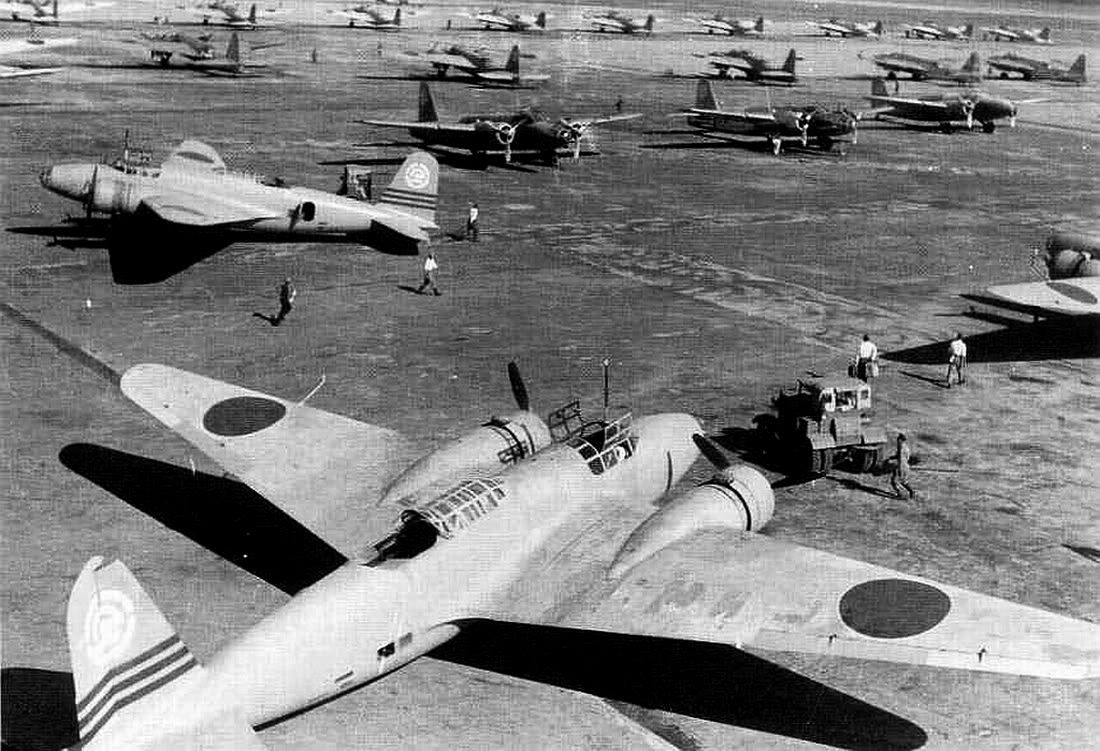
 23, 25 Dec 1941 (dates assumed): Locals have long known of the wreckage of an aircraft near a mountain top in Tak Province. Because of its location, it is assumed to have been involved in the so-called Christmas Raids on Rangoon (offsite link) on 23 and 25 December 1941. In brief summary, the plane has been identified as Japanese, of World War II vintage: available references do not provide enough detail to further identify the wreckage, and, as Ben Svasti who has visited the crash site stated, “further in-depth research, requiring extensive excavation and a forensic archaeologist, might better identify the aircraft”.1
Information which is available
While visiting Tak in Year 2000, David Hardcastle received a report of aircraft wreckage on a nearby mountain top, but did not investigate further. Checking the report in April 2018, Ben Svasti, after three hours travel in a 4-wheel drive vehicle followed by a strenuous two hour uphill hike, located the site on a mountain top in Tak Province. While much of the site was obscured by undergrowth, local villagers had collected quantities of wreckage and showed some of it to Ben:2
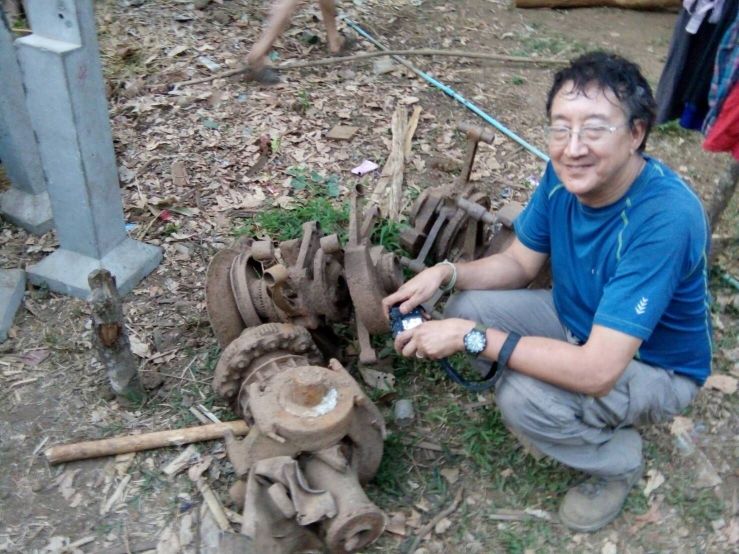 Ben Svasti with pieces of wreckage collected by villagers
Examination of the wreckage confirmed that it was that of an aircraft. Further in-depth research, requiring extensive excavation and a forensic archaeologist, as recommended by Svasti, might better identify the aircraft. Because of its location, the wreck is assumed to be that of an IJAAF bomber which participated in the “Christmas raids” on Rangoon, ie, on 23 and 25 December 1941. Svasti described his investigation further:3
- Circumstances: An eye-witness to the crash had spoken of an aircraft exploding in mid air in a cloud of white smoke (this from a local headman who knew a now-deceased informant). Debris was scattered around a wide area. Villagers did not dare approach site for many days as they were afraid of poison and disease. They later described a debris field of body parts, engine parts, and aluminum framework.
- Human remains: Following the crash, scattered body parts were in evidence. There were no survivors. Since then, human hip bones have been found by the villagers tilling the clearing for planting banana trees. Harder bone parts, particularly teeth, might be found below surface likely at a depth of 10-30 cms.
- Plane remains: The site itself is very overgrown. After a bit of searching, the villagers brought three cylinder sleeves from an engine for examination. Much of the debris will probably be about 10-30 cm. below the soil surface. Wing and fuselage parts have fallen further down the steep slope. Some engine parts have been removed from the site and were found and examined at a nearby village. There was also a report that larger plane parts have been hidden by the villagers in the area of the crash.
- Plane identification:4 From cursory examination of engine and historical records, likely a Ha-5 twin row, 14 cylinder air-cooled radial aircraft engine,5 from probably a Ki-21 twin-engine Sally Heavy Bomber.6 Alternative aircraft using the same model engine:
- Ki-30 Ann Light Bomber Nakajima: single engine;7 while the 31st Sentai used this model in the Christmas raids, Umemoto lists no Ki-30 losses during that period.
- Ki-48 Lily Light Bomber K27 Kawasaki: twin engine;8 two Hayabusas were lost in the 25 Dec 1941 Christmas raid,9 but they were single seat aircraft.
- Historical context: The year of the crash is likely late 1941-early 1942 in which IJAAF bombed British positions in Burma from bases in Thailand in support of the IJA offensive to capture Rangoon and the rest of Burma. The most likely crashed plane is the Ki-21 Sally Heavy Bomber from the 12th Sentai as a crash was recorded in historical records for this area. (Japan Defense Agency; History of the Air War in Southeast Asia (Nanpo shinko rikugun koku sakusen), 1970)
Note that details in the following are from different sources which vary, sometimes contradictorily.
IJAAF Bombers lost in the 23 December 1941 raid on Rangoon
Senshi Sosho 34 (in translation, paraphrased):10 This reference describes action over Rangoon on this date only in generalities. No information was found regarding any aircraft lost near the Thai-Burma border.
-
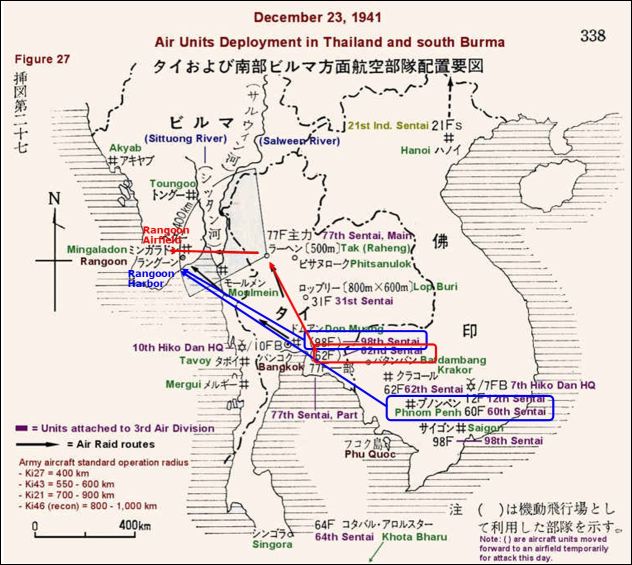
- The 98th Sentai, relocated from Saigon to Don Muang, and the 60th Sentai flying from Phnom Penh, Cambodia, both flying Ki-21s, failed to rendezvous and so flew independently to their target, Rangoon Harbor. [items in blue].
- Concurrently, the 62nd Sentai also with Ki-21s, had relocated from Phnom Penh to Don Muang in preparation for the raids on Rangoon. The unit then flew to Rahaeng, but failed to rendezvous with the 77th Sentai there, which was to provide fighter escort. As a consequence, the 62nd flew unescorted to its target, Rangoon Airport (Mingaladon). Without that escort, the 62nd Sentai suffered losses larger than expected [items in red]:11
Umemoto (in translation):
Umemoto, p 448, line 6
| Item | Japanese | English [Umemoto text ref] |
| Date | 12月23日 | 23 Dec [1941] |
| Unit | 3/62 | 62nd Sentai, 3rd Chutai |
| Aircraft lost | 九七重 | Ki-21 Heavy bomber |
| Pilot | 新岡章中尉 | Lt Akira Niioka [pp 26, 29, 31] |
| Location | ラングーン | Rangoon |
| Shooter | [67 Sqn Buffalos Sgts Bargh, William] |
67 Sqn Buffalos (Sergeants Bargh, Williams) |
| Details | 7名戦死 | 7 killed in action |
Umemoto, p 448, line 7:
| Item | Japanese | English [Umemoto text ref] |
| Date | 12月23日 | 23 Dec [1941] |
| Unit | 1/62 | 62nd Sentai, 1st Chutai |
| Aircraft lost | 九七重 | Ki-21 Heavy bomber |
| Pilot | 伊倉東雄中尉 | Lt Too Ikura [p 27]12 |
| Location | ラングーン | Rangoon |
| Shooter | 高射砲直筆 | Anti-aircraft gun |
| Details | 7名戦死 | 7 killed in action |
Umemoto, p 448, line 8:
| Item | Japanese | English [Umemoto text ref] |
| Date | 12月23日 | 23 Dec [1941] |
| Unit | 2/62 | 62nd Sentai, 2nd Chutai |
| Aircraft lost | 九七重 | Ki-21 Heavy bomber |
| Pilot | 島田篤大尉 | Capt Atsushi Shimada [p 29] |
| Location | ラングーン | Rangoon |
| Shooter | 3Sqn/AVG • P-40B | Flying Tigers, Hell’s Angels, flying P-40Bs |
| Details | 7名戦死 | 7 killed in action |
Umemoto, p 448, line 9:
| Item | Japanese | English [Umemoto text ref] |
| Date | 12月23日 | 23 Dec [1941] |
| Unit | 2/62 | 62nd Sentai, 2nd Chutai |
| Aircraft lost | 九七重 | Ki-21 Heavy bomber |
| Pilot | 佐辺慶治大尉 | Capt Keiji Sanabe [p 29] |
| Location | ラングーン | Rangoon |
| Shooter | 3Sqn/AVG • P-40B | Flying Tigers, Hell’s Angels, flying P-40Bs |
| Details | 7名戦死 | 7 killed in action |
Umemoto, p 448, line 10:
| Item | Japanese | English [Umemoto text ref] |
| Date | 12月23日 | 23 Dec [1941] |
| Unit | 3/62 | 62nd Sentai, 3rd Chutai |
| Aircraft lost | 九七重 | Ki-21 Heavy bomber |
| Pilot | 長縄正中尉 | Lt Naganawa [p 28] |
| Location | ラングーン | Rangoon |
| Shooter | 3Sqn/AVG • P-40B | Flying Tigers, Hell’s Angels, flying P-40Bs |
| Details | 7名戦死 | 7 killed in action |
Umemoto, p 449, line 5:
| Item | Japanese | English [Umemoto text ref] |
| Date | 12月23日 | 23 Dec [1941] |
| Unit | 1/98 | 98th Sentai, 1st Chutai |
| Aircraft lost | 九七重 | Ki-21 Heavy bomber |
| Pilot | 射手矢光雄中尉 | Lt Yamitsu Mitsuo [p 32] |
| Location | ラングーン | Rangoon |
| Shooter | 3Sqn/AVG • P-40B | Flying Tigers, Hell’s Angels, flying P-40Bs |
| Details | 7名戦死 | 7 killed in action |
Umemoto, p 34:
The Ki-21s of the 62nd Sentai took off from Don Muang Airfield near Bangkok. For reasons not clear, the 77th Sentai which was to provide fighter support, did not join with the 62nd. The damage on the Japanese side was enormous, with seven lost Mitsubishi Ki-21 [six whose crash locations are unclear are listed above; a seventh, piloted by Lt Nagami, 98th Sentai, 3rd Chutai, was abandoned over Rangoon harbor, with some crew parachuting out.]
Shores, et al:13
. . . the JAAF moved the 62nd and 98th Sentais [both with Ki 21 twin-engined heavy bombers] to Don Muang for operations over Burma . . . .
Tuesday, 23 December [1941]
To carry out this raid — which was directed against Rangoon and its airfields — 27 Ki 21s from the 60th Sentai [Phnom Penh] and 18 from the 98th Sentai [Don Muang] set out first, followed by 15 more Ki 21s from the 62 Sentai [Don Muang], 27 Ki 30s [single-engined light bombers] from the 31st Sentai [Lopburi] . . . . The 60th and 98th Sentais made for the docks and harbor, while the 62nd and 31st attacked Mingaladon [Rangoon’s main airport] itself.
. . . During the attack on the docks, the 98th Sentai lost the two Ki 21s . . . whilst over the airfield the 62nd lost five more, and the other ten bombers of this formation all suffered damage. . . no losses were suffered by . . . the Ki 30s of the 31st Sentai.
Ford:14
. . . Tuesday, December 23 . . . sixty Mitsubishi heavy bombers [Ki-21s] lifted off from the airports at Bangkok and Phnom Penh. . . .
Sugawara . . . assigned Mingaladon airport to the weakest group, the 62nd Sentai, mustering only fifteen early-model Sallys. . . . The Mingaladon attack would be bolstered by the 31st Sentai [Ki-30s] from Phitsanulok . . . . [they] would rendezvous over Rahaeng . . . .
. . . The 62nd Sentai’s actual losses on Tuesday morning came to five Sallys and their crew of thirty . . . A Japanese account has three of the big bombers destroyed by the AVG . . ., a fourth by the RAF . . ., and the fifth . . . by an antiaircraft shell after it was knocked out of formation by Allied fighters.
. . . the 98th Sentai returned to Thailand . . . two bombers lost . . . [as noted above, one was lost over Rangoon harbor]
Richard L. Dunn:15
On December 23rd, [units of the 3rd Flying Group (3rd FG) attacking Rangoon:
-
-
-
- 7th Flying Brigade (7th FB: 45 Ki-21 (heavy bombers) )
- 60th Flying Regiment (60th FR: Ki-21 (heavy bombers) )
- 98th Flying Regiment (98th FR: Ki-21)
- 10th Flying Brigade (10th FB (mixed aircraft) )
- 31st Flying Regiment (31st FR: 27 Ki-30s (light bombers) )
- 62nd Flying Regiment (62nd FR: 15 Ki-21s)
- 77th Flying Regiment (77th FR: 30 Ki-27s (Nakajima fighters) ) ]16
- 7th Flying Brigade (7th FB: 45 Ki-21 (heavy bombers) )
-
-
. . . 7th FB (60th and 98th FRs) were to rendezvous at Bangkok and proceed to the target [Rangoon docks] unescorted. . . [For the 10th FB] the 62nd FR [was] to rendezvous with . . . the 31st and 77th FRs over the forward base at Raheng and fly to Rangoon [Mingaladon Airfield].
[The 7th FB 60th and 98th FRs] bombers . . . never joined forces and each sentai proceeded to their target, the Rangoon docks, independently. [The 10th FB] 62nd FR left the rendezvous point at Raheng early [not joining with] . . . the other two units [the 31st and the 77th FRs]. Their [joint] target was the main military airfield near Rangoon, Mingaladon. The 27 light bombers of the 31st FR followed, [c]overed by thirty fighters of the 77th . . . [thus] the light bombers were the only bombers with an escort [on the 23 December raid].
The intercepting [AVG] fighters first encountered the fifteen [Ki-21] I bombers of the 62nd FR and this unit suffered heavily eventually losing five aircraft with the others damaged. Later the 98th FR was heavily assailed and lost two bombers with others shot up. The trailing 60th FR was also subjected to a few attacks but lost no aircraft.
IJAAF Bombers lost in the 25 December 1941 raid on Rangoon
Senshi Sosho 34:(in translation):17
This reference describes the action over Rangoon on this date only in generalities. No information is provided regarding any aircraft lost near the Thai-Burma border.
-
-
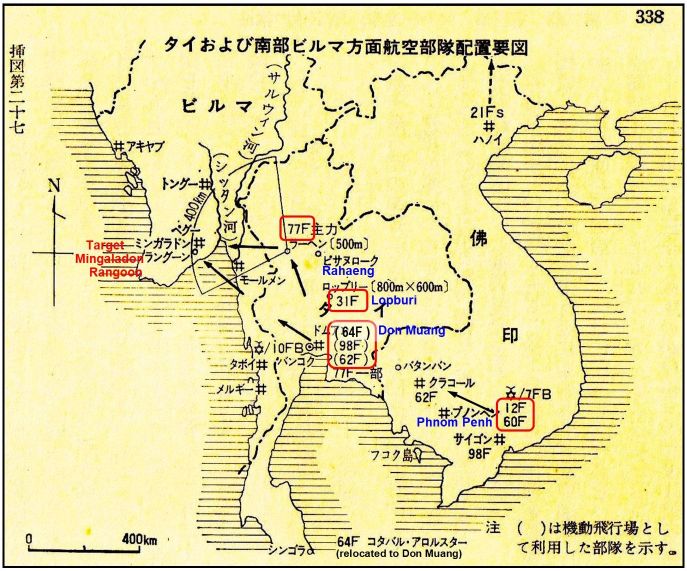
- The 12th Sentai, replacing the 98th Sentai, and the 60th Sentai, both flying from Phnom Penh with Ki-21s joined to attack Rangoon. The 64th Sentai, flying Ki-43s fighters, were to act as escorts. The lead plane in the 12th Sentai had engine trouble and dropped out, unintentionally followed by six more 12th Sentai bombers, leaving 20 heavy bombers to hit Rangoon.
- Concurrently, the 62nd Sentai also with Ki-21s, again flew to Rahaeng, to rendezvous with the 31st Sentai Ki-30s and the 77th Sentai Ki-27s and on to target, Rangoon Airport (Mingaladon). [relevant items in red]:18
-
. . . there were no fighter escorts with the 12th flight squadron, and so the bombers were directly attacked by high-speed enemy fighters. . . . the enemy fighters were ahead of the 12th Squadron, which was easy to attack due to their small number.
Umemoto
p 450, line 1:
| Item | Japanese | English |
| Date | 12月25日 | 25 Dec [1941] |
| Unit | 12 | 12th Sentai |
| Aircraft lost | 九七重 | Ki-21 Heavy bomber |
| Pilot | 林正三中尉 | Lt Shozo Hayashi [p 41] |
| Location | ラングーン | Rangoon |
| Shooter | 3Sqn/AVG • P-40B | Flying Tigers, Hell’s Angels, flying P-40Bs |
| Details | 7名戦死 | 7 killed in action |
p 450, line 2:
| Item | Japanese | English |
| Date | 12月25日 | 25 Dec [1941] |
| Unit | 12 | 12th Sentai |
| Aircraft lost | 九七重 | Ki-21 Heavy bomber |
| Pilot | 野元鉄郎中尉 | Lt Tetsuro Nomoto [Hoshino? p41] |
| Location | ラングーン | Rangoon |
| Shooter | 3Sqn/AVG • P-40B | Flying Tigers, Hell’s Angels, flying P-40Bs |
| Details | 7名戦死 | 7 killed in action |
p 450, line 3:
| Item | Japanese | English |
| Date | 12月25日 | 25 Dec [1941] |
| Unit | 12 | 12th Sentai |
| Aircraft lost | 九七重 | Ki-21 Heavy bomber |
| Pilot | 渡辺護中尉 | Lt Mamoru Watanabe [p 41] |
| Location | ラングーン | Rangoon |
| Shooter | 3Sqn/AVG • P-40B | Flying Tigers, Hell’s Angels, flying P-40Bs |
| Details | 7名戦死 | 7 killed in action |
p 41
Five total Sentai 12 Ki-21s were lost. Three were shot down over the battlefield: Lt Shozo Hayashi [450 line 1], Lt Tetsuro Hoshino [Nomoto? p 450 line 2], and Lt Mamoru Watanabe [450 line 3]. Another Ki-21 crashed (Lt Miyawaki), but the crew were all rescued. One Ki-21 (Lt Otake Kinshigero) crash landed on return to his Phnom Penh base [Cambodia], wrecking the plane.
Shores, et al:19
Thursday, 25 December
. . . units of the 7th Flying Battalion were off first, 27 Ki 21s from the 12th and 36 from the 60th Sentais . . . The 10th Flying Battalion followed, with eight Ki 21s of the 62nd Sentai, 27 Ki 30s of the 31st . . . On the way the leading Ki 21 of the 12th Sentai suffered an engine failure and turned back.
. . . The separate 12th Sentai suffered most heavily, losing three Ki 21s over the target area, while a fourth was badly hit and later force-landed. . . . The following 60th Sentai . . . none actually lost. The bombers of the 10th Flying Battalion units which followed escaped loss altogether.
Ford:20
Sugawara [called] . . . From Phnom Penh came the heavy bombers of the 12th Sentai. . . . The 62nd Sentai ground crews [presumably at their relocated base at Don Muang] had patched and repaired the bombers damaged over Burma, and had eight Sally-1s fit to make the return trip. The 60th Sentai had thirty-six airworthy bombers — more than it had sent on the earlier raid — and the newly arrived 12th Sentai had twenty-seven, all heavily-armed Sally-2s.
The lead bomber [12th Sentai] . . . lost power in one engine and dropped out of the formation [along with six more bombers, along with ten Ki-43 fitghters]. . . . now far behind the 60th [which no longer had escorting Ki-43s], [the 12th flew] directly to Rangoon instead of making a planned dogleg to Moulmein.
. . . the eight battered Sally-1s of the 62nd Sentai flew north to Rahaeng and linked up with twenty-seven Anns [Ki 30s] [to target] Mingaladon.
Actual Japanese losses . . . . The heavy bomber groups, Colonel Kitajima’s divided 12th Sentai had three Sallys shot down . . . and a fourth damaged so badly that it crashed in a bamboo forest [in Malaya] on the way home, with the crew surviving. . . . Several 60th Sentai Sallys were damaged, but the hard-luck 62nd escaped without a hit . . . .
Dunn 121
On December 25th, [units of the 3rd Flying Group (3rd FG) attacking Rangoon:
-
-
-
- 7th Flying Brigade (7th FB (mixed aircraft) with >60 Ki-27s)
- 12th Flying Regiment (12th FR: 27 Ki-21s (heavy bombers) )
- 60th Flying Regiment (60th FR: 36 Ki-27s)
- 64th Flying Regiment (64th FR: 25 Ki-43s (Hayabusa fighters) )
- 10th Flying Brigade (10th FB (mixed aircraft) )
- 31st Flying Regiment (31st FR: 27 Ki-30s (light bombers) )
- 62nd Flying Regiment (62nd FR: 8 Ki-21s)
- 77th Flying Regiment (77th FR: 32 Ki-27s (Nakajima fighters) ) ]22
- 7th Flying Brigade (7th FB (mixed aircraft) with >60 Ki-27s)
-
-
The 7th FB was back with the 12th FR substituted for the 98th FR. They would be escorted by the 7th FB’s fighter unit, the 64th FR flying their Type 1 (Ki 43) fighters [relocated on 24 December from Khota Bharu to Don Muang for the 25 December action.23]. . . . The 7th FB contingent numbered over 60 heavy bombers and 25 Type 1 fighters. The 10th FB was back with 27 Type 97 light bombers, 32 Type 97 fighters, and just eight Type 97 model I heavy bombers. . . .
Eventually six of the [12th Sentai] bombers and part of the [64th Sentai] fighter escort aborted the mission . . . the 60th FR . . . continued the mission unescorted. . . . [Over Rangoon] the 77th FR dispatched fighters to defend the unescorted [60th FR]. . . . Three bombers of the 12th FR were shot down outright, a fourth crashed in Thailand . . . .
| First published on Internet | ||
Last Updated on 7 September 2026
- Photo: Warplanes of Japan: Mitsubishi Ki-21 in Military History by Harold A Skaarup (both offsite links) [↩]
- Ben Svasti email of 1700 23 Apr 2018; my ref: \02500 Tango\_Crash sites N TH for Tango\DETAIL SHEETS\J411225 Tak [J02] ok\Photo of Ben Svasti.jpg[↩]
- from Ben email 23 Apr 2018 17:00:06; and my ref: \02370 Tak (Rahaeng)\IJAAF\Ben Rpt (1)\IJAAF Planes-Ben email 20200904.pdf[↩]
- Sanpachi in the ww2aircraft.net forum suggests a first step in narrowing the field of possibilities would be to get details of the engine(s), particularly bore and stroke.[↩]
- Mitsubishi Kasei (offsite link); perhaps the Ha-101 Ki-21, per “Sally”, Japanese Heavy Bomber (offsite link) [↩]
- Mitsubishi Ki-21 (offsite link). Further research suggests the Ki-21-IIa variant which was flown by 12th, 60th, 62nd, and 98th Sentais (Mitsubishi Ki-21 (offsite link) ) which were active in the Christmas raids on Rangoon[↩]
- Ki-30 “Ann”, Japanese Light Bomber (offsite link) [↩]
- Ki-48 “Lily”, Japanese Light Bomber (offsite link) );
but use not recorded in the Christmas raids. - Ki-43 Hayabusa Fighter Nakajima: single engine;((Ki-43 “Oscar”, Japanese Fighter (offsite link) [↩]
- 梅本弘,ビルマ航空戦・上 (東京:大日本印刷株, 2002) [Umemoto, Hiroshi, Air War in Burma, vol 1 (Tokyo: Dai Nippon, 2002); [hereafter Umemoto], p449[↩]
- 戦史叢書, 南方進攻陸軍航空作戦, Vol 34, (東京: 防衛庁防衛研修所戦史室 (編集), 昭和四十五) [Senshi Sosho, Southern Army Air Operations, vol 34, (Tokyo: Asagumo Shimbunsha, 1970)], (hereafter Senshi Sosho 34) p 340; my ref: \03302 034 Senshi Sosho vol 34 (IJAAF drive)\335-345 (Rangoon)\Rangoon aabby\_335-344.docx. Note that I confess that I don’t have a good translation for this section of the Senshi Sosho, so significant details may have been missed.[↩]
- Original map from Senshi Sosho 34, p 338; markup from JAAF deployments, Dec 1941-Mar 1942 (offsite link); additional markups by author using Microsoft Publisher; my refs: \03400 Dan Ford\Marked up maps.docx, also \03302 034 Senshi Sosho vol 34 (IJAAF drive)\MAPS, markups fm Warbirds\SS34 p 338 markup.jpg[↩]
- Richard L Dunn notes a Japanese newspaper reported that Lt Ikura had piloted a Ki-30, A light bomber[↩]
- Christopher Shores & Brian Cull with Yasuho Izawa, Bloody Shambles, Volume 1 (London: Grub Street, 1992) [Shores 1, hereafter], pp 241-245[↩]
- Daniel Ford, Flying Tigers (New York: HarperCollins / Smithsonian Books, 2007) [hereafter Ford], pp 112-120[↩]
- Double Lucky (Part 1) (offsite link) [hereafter Dunn 1] unpaginated[↩]
- Reconstructed from Dunn, Part 1[↩]
- pp 341-345; and I again concede that I do not have a good translation of this section of the Senshi Sosho.[↩]
- Original map from Senshi Sosho 34, p 338; markup from JAAF deployments, Dec 1941-Mar 1942 (offsite link); additional markups by author using Microsoft Publisher to update the map to 25 Dec 1941 events; my refs: \03400 Dan Ford\Marked up maps.docx, also \03302 034 Senshi Sosho vol 34 (IJAAF drive)\MAPS, markups fm Warbirds\SS34 p 338 markup.jpg[↩]
- Shores 1, pp 246-250[↩]
- Flying Tigers, pp 127-134[↩]
- unpaginated[↩]
- Reconstructed from Dunn Part 1 and Biplane fighter aces-Japan-Lt Col Tateo Kato (offsite link) [↩]
- Biplane fighter aces-Japan-Lt Col Tateo Kato (offsite link) and Ford[↩]