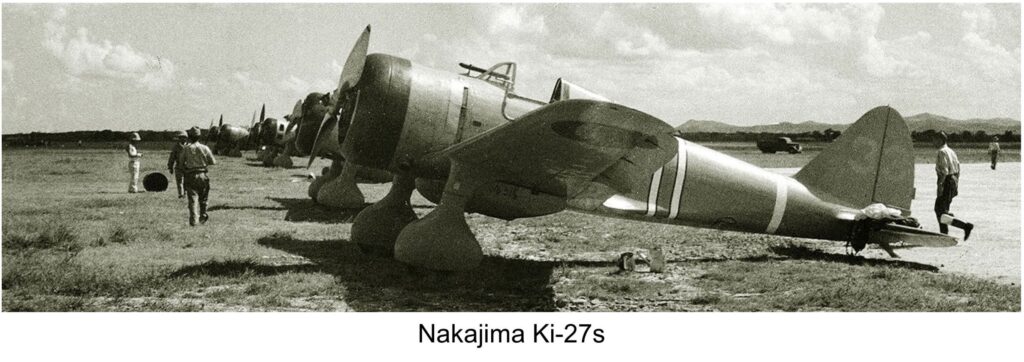
 08 Jan 1942: Four IJAAF Ki-27s1 of the 77th Sentai and one transport aircraft were all destroyed; three more Ki-27s were damaged, all on the ground at Rahaeng (Tak) Airfield2 (Google Maps link to location of old runway), by AVG 2nd Squadron P-40 strafing.
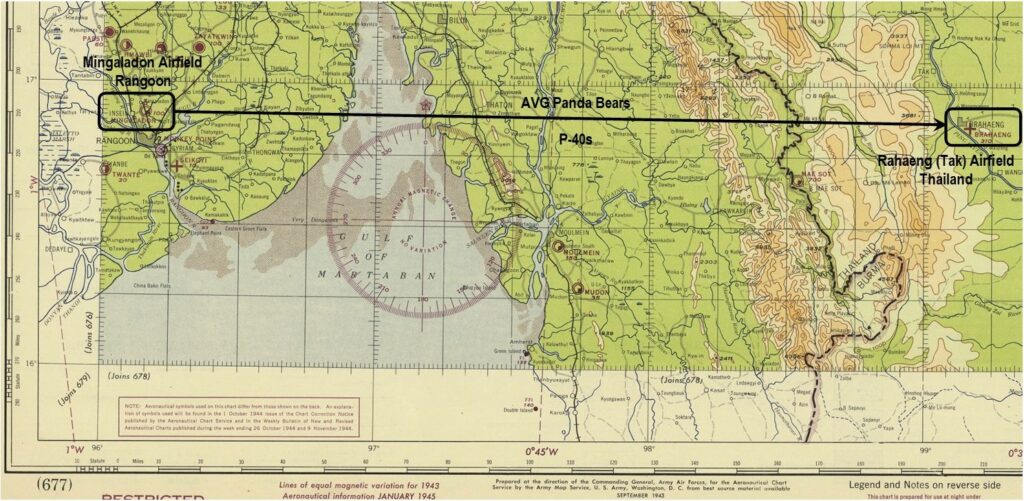
Map: Rangoon is roughly 330 km west of Rahaeng:4
References
- Senshi Sosho 34:5
pp 592-606: no mention.
- Umemoto:6
p 451, line 12:
| Item | Japanese | English7 |
| Date | 1月8日 | 08 Jan 1942 |
| Unit | 1/77 | 77th Sentai, 1st Chutai |
| Aircraft lost | 九七戦 | Ki-27 Fighter |
| Pilot | 不明 | Unknown |
| Location | ラーへン飛行場 | Rahaeng (Tak) Airfield |
| Shooter | 2Sqn/AVG P-40B対地攻撃 |
2nd Squadron/AVG P-40Bs ground attack |
| Details | 地上で炎上 | Burned on the ground |
p 451, line 13:
| Item | Japanese | English |
| Date | 1月8日 | 08 Jan 1942 |
| Unit | 1/77 | 77th Sentai, 1st Chutai |
| Aircraft lost | 九七戦 | Ki-27 Fighter |
| Pilot | 不明 | Unknown |
| Location | ラーへン飛行場 | Rahaeng (Tak) Airfield |
| Shooter | 2Sqn/AVG P-40B対地攻撃 |
2nd Squadron/AVG P-40Bs ground attack |
| Details | 地上で炎上 | Burned on the ground |
p 451, line 14:
| Item | Japanese | English |
| Date | 1月8日 | 08 Jan 1942 |
| Unit | 1/77 | 77th Sentai, 1st Chutai |
| Aircraft lost | 九七戦 | Ki-27 Fighter |
| Pilot | 不明 | Unknown |
| Location | ラーへン飛行場 | Rahaeng (Tak) Airfield |
| Shooter | 2Sqn/AVG P-40B対地攻撃 |
2nd Squadron/AVG P-40Bs ground attack |
| Details | 地上で炎上 | Burned on the ground |
p 451, line 15:
| Item | Japanese | English |
| Date | 1月8日 | 08 Jan 1942 |
| Unit | 77 | 77th Sentai |
| Aircraft lost | 九七戦 | Ki-27 Fighter |
| Pilot | 不明 | Unknown |
| Location | ラーへン飛行場 | Rahaeng (Tak) Airfield |
| Shooter | 2Sqn/AVG P-40B対地攻撃 |
2nd Squadron/AVG P-40Bs ground attack |
| Details | 地上で損傷 | Damaged on the ground |
p 451, line 16:
| Item | Japanese | English |
| Aircraft lost | 九七戦 | Ki-27 Fighter |
| Pilot | 不明 | Unknown |
| Location | ラーへン飛行場 | Rahaeng (Tak) Airfield |
| Shooter | 2Sqn/AVG P-40B対地攻撃 |
2nd Squadron/AVG P-40Bs ground attack |
| Details | 地上で損傷 | Damaged on the ground |
p 451, line 17:
| Item | Japanese | English |
| Aircraft lost | 九七戦 | Ki-27 Fighter |
| Pilot | 不明 | Unknown |
| Location | ラーへン飛行場 | Rahaeng (Tak) Airfield |
| Shooter | 2Sqn/AVG P-40B対地攻撃 |
2nd Squadron/AVG P-40Bs ground attack |
| Details | 地上で損傷 | Damaged on the ground |
p 451, line 18:
| Item | Japanese | English |
| Aircraft lost | 輸送機 | Transport aircraft |
| Pilot | 不明 | Unknown |
| Location | ラーへン飛行場 | Rahaeng (Tak) Airfield |
| Shooter | 2Sqn/AVG P-40B対地攻撃 |
2nd Squadron/AVG P-40Bs ground attack |
| Details | 地上で損傷 | Burned on the ground |
pp 50-51:
1月8日、日本軍飛行場襲撃を繰り返す連合軍機を追尾攻撃するため、ラーへン飛行場では、77戦隊 第1中隊の九七戦1個編隊3機が常時、警急姿勢(始動車を着け、機内で操縦者が待機、ただちに離陸 できる態勢)をとっていた。この日の14時、P-40が4機、ラーへンを襲った。米義勇航空群「パンダ. ベアーズ」のP40は、1機が上空掩護に残り、3機が地上掃射を行った。パーシー.バーテルトのP40 は四航過、ムース.モスは炎上機の黒煙が立ち昇る中を執拗に六航過も攻撃、少なくとも地上では8機 が燃えていたと報告している。実際、地上では輸送機1機を含む4機が炎上、2機が中破、1機が損傷 した。P40はおよそ15分も暴れ回ってから飛行場上空を離れた。間髪を入れず江藤大尉率いる九七戦3 機が離陸、モールメン飛行場まで追尾を試みたが、在地機を発見できず空しく帰還した。日本側はモー間髪を入れず江藤大尉率いる九七戦3 機が離陸、モールメン飛行場まで追尾を試みたが、在地機を発見できず空しく帰還した。日本側はモールメンからの空襲と思いこんでいたが、P40はミンガラドンから飛来していたのだ。
[Translation] On 08 January [1942], in order to track and attack Allied aircraft that were repeatedly attacking the IJAAF’s Rahaeng Airfield, three aircraft of the 77th Squadron 1st Company, Nakajima Ki-27, were always in an alert position (with a starting vehicle attached to one)8. Pilots were on standby in a hut on the flight line, ready to take off immediately. At 14:00, four P-40s attacked Rahaeng. One in the AVG P-40s squadron, the “Panda Bears”, remained high for air cover, and three went strafing. Percy Bartelt’s P-40 reported four strafing runs, while Moose Moss made six runs while the black smoke of the flaming planes were rising. Moss reported that at least eight were burning on the ground. In fact, four aircraft, including one transport aircraft, were on fire, two had received medium damage, and one was severely damaged [Total: the seven that Umemoto lists: four burned on the ground]. The P-40s rampaged for about 15 minutes before leaving the airfield.
- Shores, et al:9
Thursday, 8 January [1942]
. . . A few hours after the Blenheims had completed their attack on Bangkok, four 2nd AVG Squadron P-40s were dispatched [from Mingaladon] to strafe Mesoht airfield, where they claimed eight aircraft destroyed on the ground; the Japanese reported that four Ki 27s of the 77th Sentai were burned and three damaged, and that a transport aircraft was also destroyed in flames — but at Raheng, rather than Mesoht.
- Ford:10
After sunrise, RAF 113 Squadron returned from Bangkok . . . .
The Panda Bears returned to Thailand that afternoon, January 8. Charlie Mott led the mission, accompanied by Robert (Moose) Moss, Gil Bright, and Percy Bartelt. Their target was Mae Sot, in the valley [formed by the Moei, aka, Thaungyin River] that marked the Thai-Burma frontier, where the Japanese were building a new airfield [untrue11 ]. Leaving Bright to fly top cover at 6,000 feet, Mott and the others “went down to do the business,” [and Mott was shot down (see A201008 Mott].
Moose Moss—the stocky pilot who’d traveled as an acrobat to Southeast Asia—kept strafing the Japanese aircraft. “I made three passes down the main line of the parked enemy aircraft,” he reported. “The smoke and fire from burning aircraft was bad so I turned perpendicular to the line.” He made six passes altogether, estimating that eight planes were burning when he left the scene.
The estimate was confirmed by Percy Bartelt. “My first run was made on an observation plane and carried on through the line of fighters, he reported. He next made two runs on the fighters, a fourth on the plane he thought was a scout, and a fifth on some tents bordering the field. By this time, Bartelt had only two rifle-caliber guns firing, so he broke off and followed Moss to the westward. “There were eight burning when we left,” he concluded. The planes were divided among the pilots in the raid: one for Gil Bright, two each for Moss and Bartelt, and three for the missing Charlie Mott.
The 77th Sentai had indeed taken a serious hit. Four Nates were destroyed at Mae Sot, and three fighters and a transport (Bartelt’s reconnaissance plane, no doubt) were damaged.
- Dunn:12
. . . The following day the 3rd chutai was sent south to Singora to support operations in the lower Kra Isthmus leaving a weakened 77th in the north. The unit was further weakened when an AVG strafing attack destroyed four Type 97 fighters and damaged others on the ground at their forward base in Thailand.
| First published on Internet | ||
Last Updated on 7 September 2026
- Photo: File:Nakajima Ki-27 at Kwangtung.jpg (offsite link); my ref: \02500 Tango\_Crash sites N TH for Tango\DETAIL SHEETS\J420108 Tak [J04]\Ki-27. Combat Use.jpg[↩]
- N16°52.65 E99°09.02[↩]
- N16°42.06 E98°32.54[↩]
- Extract from (677) Gulf of Martaba: McMaster Collection, Canada (offsite link); my ref: PROJECT\_MAPS\THAILAND Maps\COLLECTN McMASTER\677-macrepo_76844 1942 pt-enh.jpg in \02500 Tango\_Crash sites N TH for Tango\DETAIL SHEETS\J420103 Tak [J03]\J420108 Tak.pub\Sheet 4 (J420108 map.jpg) [↩]
- 戦史叢書, 南方進攻陸軍航空作戦, Vol 34
(東京: 防衛庁防衛研修所戦史室 (編集), 1970年)
[Senshi Sosho, Southern Army Air Operations, vol 34
(Tokyo: Asagumo Shimbunsha, 1970)] [↩] - 梅本弘,ビルマ航空戦・上 (東京:大日本印刷株, 2002) [Umemoto, Hiroshi, Air War in Burma, vol 1 (Tokyo: Dai Nippon, 2002)] hereafter, Umemoto[↩]
- Google translation (typical) [↩]
- The Ki-27 fighter did not have an electric starter, having instead to rely on an external, truck-mounted engine to engage and rotate the fighter’s nine-cylinder radial engine.[↩]
- Shores, et al, Bloody Shambles, vol 1 (London: Grub Street, 1992), p 254[↩]
- Ford, Daniel, Flying Tigers (Washington: Smithsonian, 2007) pp 150-153[↩]
- The airfield at Mae Sot had been constructed by the Aerial Transort Company in 1938 as the western terminus of a branch providing mail and passenger service with Phitsanulok (EM Young, Aerial Nationalism (Washington: Smithsonian, 1995), pp 99-100) .[↩]
- Richard Dunn, Double Lucky? (offsite link) (unpaginated) [↩]