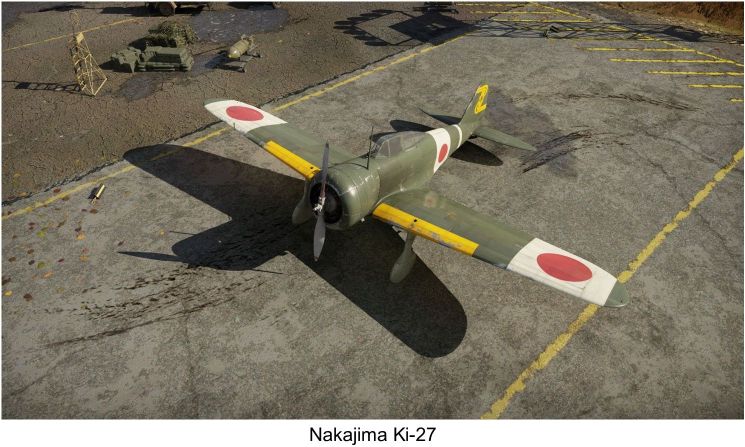
 03 Jan 1942: at Rahaeng (Tak) Airfield1 (Google Maps link to location of older runway, now abandoned with site redeveloped), one Ki-272 was shot down with pilot, Wt Off Yokoyama, badly wounded; on the ground, the AVG 2nd Squadron strafed and destroyed one more Ki-27, and finally “wrecked” two more. All IJAAF aircraft were in the 77th Sentai.
After Japan’s Christmas Raids on Rangoon3 (Google Maps link), 23 and 25 December 1941, there had been no follow-up Japanese action. With three days of quiet resting uneasily on local Allied command, a change in tactics was decided resulting in Jack Newkirk, heading the Flying Tiger Pandas, announcing to his unit, “Let’s take the war to the enemy!”4 With that, the first Japanese target selected was Tak Airfield. It was a forward base, 70 km inside the Thai border, with just three 77th Sentai Ki-27s detached there. Flying out of Mingaladon5 (Google Maps link) on 03 January, three Panda P-40s attacked the Tak airfield, while nine Ki-27s were just returning from bombing the British-held Moulmein Airfield. In the resulting melee, four Ki-27s were basically destroyed and one Japanese pilot seriously injured. Although badly shot up, all three P-40s returned to Mingaladon.
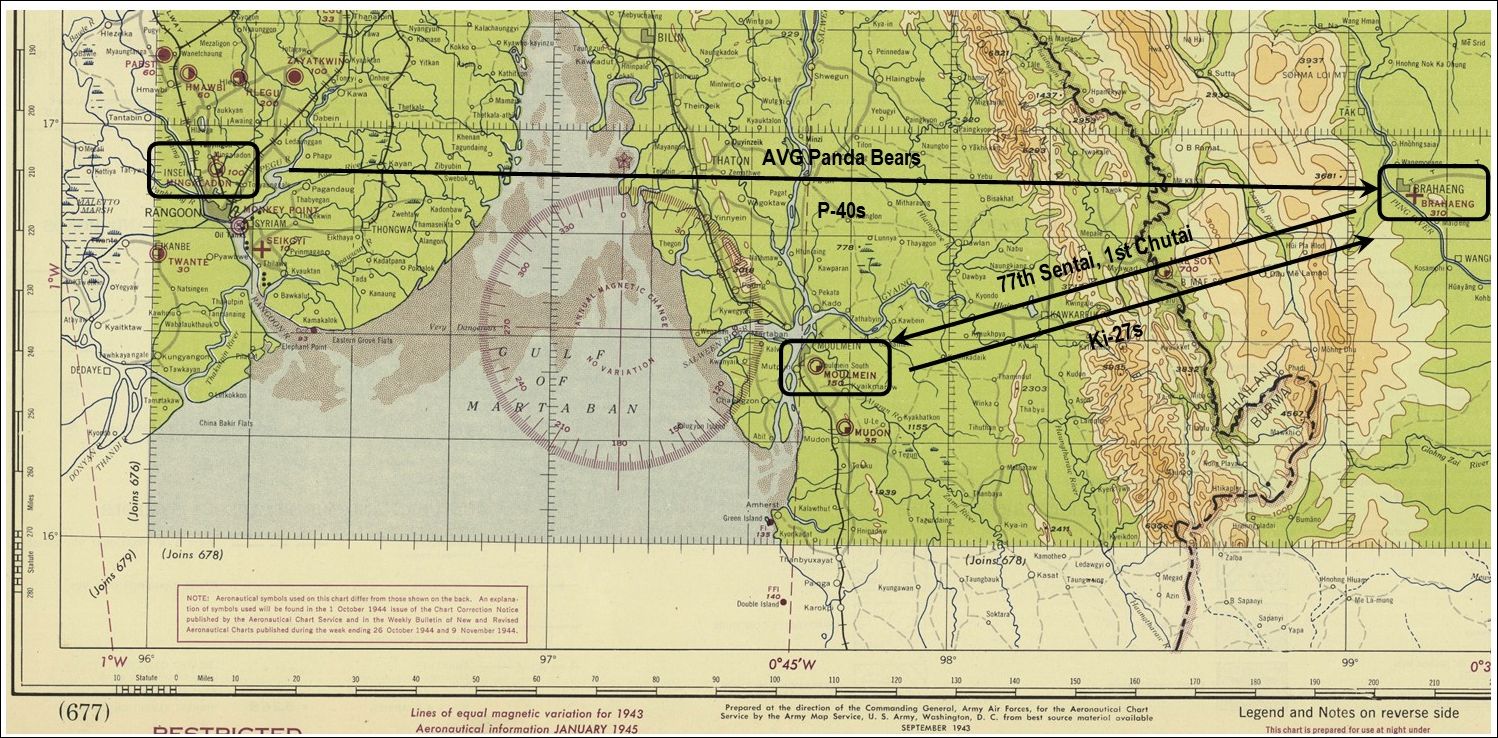
The Panda P-40s had flown almost directly east from Mangaladon Airfield at Rangoon for 320 km to reach Tak. The 77th Sensai Ki-27s were returning to Tak on a ENE heading from a 330 km round-trip attack on Moulmein6 (Google Maps link):7
References:
• Senshi Sosho 34:
[Awaiting translation of applicable text: pp 592-606]
戦史叢書, 南方進攻陸軍航空作戦, Vol 34
(東京: 防衛庁防衛研修所戦史室 (編集), 1970年)
Senshi Sosho, Southern Army Air Operations, vol 34
(Tokyo: Asagumo Shimbunsha, 1970)
• Umemoto8 (in translation):
p 451, line 1:
| Item | Japanese | English9 |
| Date | 1月3日 | 03 Jan 1942 |
| Unit | 1/77 | 77th Sentai, 1st Chutai |
| Aircraft lost | 九七戦 | Ki-27 Fighter |
| Pilot | 績山准尉 | Warrant Officer |
| Location | ラーへン飛行場 | Rahaeng (Tak) Airfield |
| Shooter | 2Sqn/AVG • P-40B | Flying Tigers, Panda Bears, flying P-40Bs |
| Details | 不時着・重傷 | Crash landing ・ serious injury |
p 451, line 2:
| Item | Japanese | English |
| Date | 1月3日 | 03 Jan 1942 |
| Unit | 1/77 | 77th Sentai, 1st Chutai |
| Aircraft lost | 九七戦 | Ki-27 Fighter |
| Pilot | 不明 | Unknown |
| Location | ラーへン飛行場 | Rahaeng (Tak) Airfield |
| Shooter | 2Sqn/AVG・P-40B
対地攻撃 |
Flying Tigers, Panda Bears, flying P‑40Bs, ground attack |
| Details | 地上で炎上 | Burned on the ground |
p 451, line 3:
| Item | Japanese | English |
| Date | 1月3日 | 03 Jan 1942 |
| Unit | 1/77 | 77th Sentai, 1st Chutai |
| Aircraft lost | 九七戦 | Ki-27 Fighter |
| Pilot | 不明 | Unknown |
| Location | ラーへン飛行場 | Rahaeng (Tak) Airfield |
| Shooter | 2Sqn/AVG・P-40B
対地攻撃 |
Flying Tigers, Panda Bears, flying P‑40Bs, ground attack |
| Details | 地上で大破 | Wrecked on the ground |
p 451, line 4:
| Item | Japanese | English |
| Date | 1月3日 | 03 Jan 1942 |
| Unit | 1/77 | 77th Sentai, 1st Chutai |
| Aircraft lost | 九七戦 | Ki-27 Fighter |
| Pilot | 不明 | Unknown |
| Location | ラーへン飛行場 | Rahaeng (Tak) Airfield |
| Shooter | 2Sqn/AVG・P-40B
対地攻撃 |
Flying Tigers, Panda Bears, flying P‑40Bs, ground attack |
| Details | 地上で大破 | Wrecked on the ground |
梅本弘,ビルマ航空戦・上 (東京:大日本印刷株, 2002), p 451
Umemoto, Hiroshi, Air War in Burma, vol 1
(Tokyo: Dai Nippon, 2002), p 451
• Shores, et al:10
Saturday, 3 January [1942]
During the morning nine Ki-27s from the 77th Sentai took off from Lampong [sic], refueled at Raheng, and then made a strafing attack on Moulmein airfield. . . .
As this attack on Moulmein was underway, Sqn Ldr Jack Newkirk had led three P-40s of the 2nd AVG Squadron off to strafe Raheng [Tak] airfield in Thailand —the base to which the departing Ki 27s were now [returning]. Some of the Japanese fighters had just landed as Newkirk, Vice Sqn Ldr James Howard, and Fit Ldr David Hill approached, while the 77th’s third element actually followed the P-40s in — again mistaking them for Spitfires.
Seeing many aircraft lined up on the ground, Howard went down to strafe unaware that he had a Ki 27 on his tail. Newkirk turned in behind this, opened fire and reported that it crash-landed, turned over and burst into flames. Hill meanwhile claimed another fighter shot off Newkirk’s tail, and Newkirk then claimed another before heading for home, whilst Howard reported the destruction of four fighters on the ground; troops who were firing at the strafers were also attacked. Newkirk did not realise that he had been under attack himself until he was shown the tail of his aircraft, which was peppered with 22 7.7mm bullet holes. He was credited with a ‘Zero’ and an ‘I-96’ shot down, the other fighters not being specifically identified.
During the fight Sgt Maj Matsunaga claimed one of the attackers shot down and Lt Beppu one probable, but Wt Off Yokoyama was shot down and badly wounded. On the ground one Ki 27 was burned, one badly damaged and one damaged to a lesser extent.
Shores, et al, Bloody Shambles, Vol 1
(London: Grub Street, 1992), pp 252-253
• Ford:11
. . . frustrated to find tha the Japanese had declared a truce in their campaign against Rangoon. . . .[Jack] Newkirk called the Panda Bears together and said: “Let’s take the war to the enemy”. . . . He was following the orders of Air Vice Marshal Donald Stevenson . . . on January 2nd. . . .
The first target was an airstrip near the village of Tak, fifty miles into Thailand, beyond the mountain ranges that guarded the frontier. The Japanese called this field Raheng, and its usual garrison was a three-plane detachment from the 77th Sentai. However, Captain Eto Toyoki had spent the night with nine Nates in order to mount a dawn attack on the RAF base at Moulmein. The raiders must have lifted off at about the same moment—Newkirk from Mingaladon, Eto from Tak/ Raheng—just before sunrise on Saturday, January 3.
The Tomahawks . . . flew into Thailand against the rising sun. Newkirk led the flight beyond Tak, then circled back so the Panda Bears would have the sun at their backs. Dropping down at 250 mph toward the airstrip, they were elated to see Japanese fighters like sitting ducks on the gravel field, their propellers turning—about to take off, as the Americans assumed, but in fact just landed from their attack on Moulmein. . . . As the Japanese told the story, three Nates were on the ground and three more just touching down when they were attacked by “Spitfires” out of the sun.
“I got so preoccupied with seeing the enemy planes on the ground,” Tex Hill recalled, “that I didn’t think about looking up. The three of us bent ’em over, and as we approached the field I looked up and there were three more planes in the traffic pattern with us. Like lightning, one Jap tacked onto Jim Howard’s tail and was eating him up.” This was Captain Eto’s third flight, which had been about to land in its turn.
Since Tex was committed to the strafing run, that left Jack Newkirk to deal with the intruders. “I saw two enemy aircraft circling the field at 2,000 feet,” he reported, “and attacked the nearest plane … from astern. After two twists it turned to the left streaming smoke, rolled over, and crashed into the jungle. Vice Squadron Leader J. H. Howard at this time strafed the field and I saw a large fire as the result.”
One of the AVGs would dub Jim Howard “the automatic pilot” for his methodical way of carrying out his duties. As Howard told the story in a 1991 memoir, he knew the Japanese planes were in the air but chose to ignore them. “Our intended mission was to strafe the planes on the field,” he wrote, “so I bore in to catch the prizes on the ground.” He gave a five-second-burst to a fighter that seemed to be taxiing for takeoff. . . . Meanwhile, the airborne Nate clung to his tail with both machine guns chattering—eating him up, in Tex Hill’s phrase.
Tex now quit his own strafing run in favor of the live target: “I pulled around on him as quickly as I could and started firing as I did. I didn’t even look through the gunsight—just watched the tracers like following a garden hose. With my diving speed built up, I came right up on him and he blew up. I flew through the debris and pulled up to come around and meet another Jap coming straight at me.”
Having dispatched his first quarry, as he thought, Jack Newkirk went after another—evidently the Nate that was attacking Tex Hill. Newkirk got on its tail and fired several bursts, only to have it loop up and over “in the most quick and surprising manner.” The Nate rolled upright as it doubled back, so it was now flying straight at the Tomahawk— an Immelmann turn, developed during World War I and still a favorite of the Japanese. “Both of us were firing head on at each other,” Newkirk wrote in his combat report, “and he pulled up over me. Several particles fell from his plane and he stalled and spun into the jungle.”
Meanwhile Jim Howard finished his strafing run and returned for another: “I roared down the line of idling aircraft with my thumb on the firing button all the way. The machine guns left a wonderful line of destruction the length of that array of fighters. I hauled back on the stick for the getaway. Nothing doing! As the nose came up, a dull thump shook my fighter. . . . Smoke poured from the cowling and the screaming Allison went dead. My prop idled to a windmill. I had been hit by ground fire.” Howard circled back to land among the planes he’d just been strafing. Then a miracle: the Allison coughed to life. He brought the nose up and found himself flying in formation with two Nates, their pilots evidently focused on the flame and confusion on the ground.
. . . Japanese records show two Nates damaged on the field and one shot down: Warrant Officer Yokoyama, who would need two months to recover from his wounds. . . .
Ford, Daniel, Flying Tigers (Washington: Smithsonian, 2007), pp 142-145
• Dunn:12
As the sole Japanese fighter unit in Thailand at this time, the 77th had to cover many bases. Its main strength moved north to Lampang leaving one squadron at Bangkok for defense of the bombers and maintenance units based there. One flight of fighters was maintained at the forward base at Raheng.
On January 2nd [1942], a squadron of the 77th deployed from their base at Lampang to the forward operating base at Rahang. From there early the next morning Capt. Toyoki Eto led nine Type 97 fighters to attack the airfield at Moulmein.
The nine fighters returned to Raheng and most had landed when three Tomahawks appeared. . . .
Howard followed the mission’s plan and went down to strafe what he took to be a formation of Japanese fighters preparing to take off (rather than just having landed). He claimed four fighters destroyed on the ground and also strafed personnel on the airfield during successive attacks. The other pilots sighted three Japanese fighters over the field and broke off their strafing runs. Howard was followed by a Type 97 fighter and when his engine received a hit and began to lose power, he assumed he had been hit by ground fire. Hill attacked the Japanese fighter chasing Howard. Newkirk claimed one that crashed landed and burst into flames. Hill fired at a fighter on Newkirk’s tail. Newkirk claimed a second fighter and was credited with a Zero and an I-96 destroyed. Hill was also credited with a kill. Howard prepared to crash land his stricken fighter and no doubt was seen by the Japanese with his propeller stationary (they reported two Spitfires trailing smoke). At low level he managed to bring the engine to life and limped back to Rangoon.
One Type 97 fighter was lost with its pilot badly wounded. The other two landed safely with Lt. Beppu adding a probable to his earlier ground kill and Sgt. Maj. Matsunaga claiming one of the “Spitfires” (presumably Howard) destroyed. Howard returned with 7.7mm hits in his tail, fuselage, and armor plate in addition to his damaged engine. Newkirk had twenty-two holes in the tail of his Tomahawk. Back at Raheng one Type 97 fighter had been burned out and another badly damaged on the ground. A third fighter had suffered minor damage.
Richard Dunn, Double Lucky? (offsite link) (unpaginated)
| First published on Internet | ||
Last Updated on 7 September 2026
- N16°52.65 E99°09.02[↩]
- Photo: Ki-27 otsu Tachiarai (offsite link); my ref: \02500 Tango\_Crash sites N TH for Tango\DETAIL SHEETS\J420103 Tak [J03]\Ki-27 labeled-red.jpg[↩]
- N16°50 E96°10[↩]
- Daniel Ford, Flying Tigers (New York: HarperCollins / Smithsonian Books, 2007) [hereafter Ford], p 142[↩]
- N16°54′26 E96°07′59[↩]
- N16°26.70 E97°39.66[↩]
- Markup by author using Microsoft Publisher of extract from AAF Aeronautical Chart, 677 Gulf of Martaban, dated Sep 1942 with aeronautical information updated to Jan 1945, in McMaster Collection, (offsite link) Canada; my refs: bPROJECT\_MAPS\THAILAND Maps\COLLECTN McMASTER\677-macrepo_76844 1942 pt-enh.jpg in \02500 Tango\_Crash sites N TH for Tango\DETAIL SHEETS\J420103 Tak [J03]\J420103 Tak.pub\Sheet 3 (677 extr.jpg) [↩]
- 梅本弘,ビルマ航空戦・上 (東京:大日本印刷株, 2002) [Umemoto, Hiroshi, Air War in Burma, vol 1 (Tokyo: Dai Nippon, 2002); [hereafter Umemoto], p 451[↩]
- Google translation (typical) [↩]
- Shores, et al, Bloody Shambles, Vol 1 (London: Grub Street, 1992), pp 252-253[↩]
- Ford, Daniel, Flying Tigers (Washington: Smithsonian, 2007), pp 142-145[↩]
- Richard Dunn, Double Lucky? (offsite link) (unpaginated) [↩]