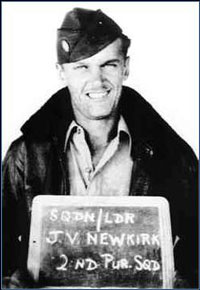
 24 Mar 1942: Jack Newkirk was a pilot assigned to the Flying Tigers (offsite link), more properly, the American Volunteer Group or AVG (offsite link). He flew as Squadron Leader for the 2nd Squadron (nicknamed the “Panda Bears”).1,2
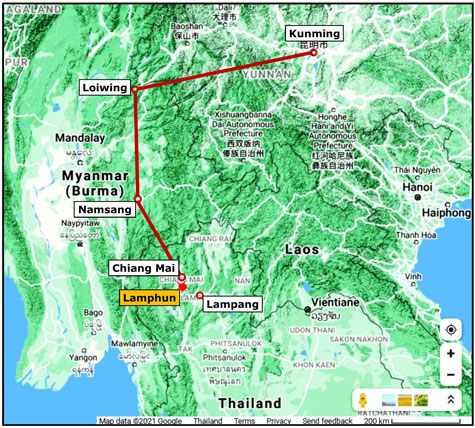
On this date, ten AVG P-40s having earlier flown out of Kunming, Yunnan (Google Maps link) to Loiwing (Leiyun), Yunnan (Google Maps link) and on to Namsang, Burma (Google Maps link), attacked targets in northwest Thailand. Split into two groups, four of the P-40s led by Jack Newkirk were to attack Lampang (the remaining six, which were to attack targets in Chiang Mai, included William McGarry). Newkirk used the Chiang Mai Railway Station (Google Maps link) as a landmark, with his target a further 80 air-km southeast along the railway. After strafing the station, he therefore followed down the railway line towards Lampang Airfield (Google Maps link). On the way, he passed over Lamphun (Google Maps link) which was only 25 km SSE of Chiang Mai:3
Perhaps attracted by sighting three different airstrips in the area,4 Newkirk led the flight in circling the area. What happened then regarding Jack Newkirk’s crash in Lamphun is in dispute.
Sequence of events as reported by pilots in 1942. Lawlor, one of the pilots in the flight, reported passing by the two smaller airstrips which appeared unoccupied to target the barracks around the largest airstrip which would have been RTAF Lamphun, located east of Lamphun town. Newkirk then turned north, back towards Chiang Mai. Another pilot on the flight, Henry Geselbracht, reported the next target encountered as “two vehicles on the road south of Chiang Mai”. Following Newkirk in attacking the vehicles, Geselbracht fired on them after Newkirk cleared the target, but noted a flash beyond the target. Geselbracht later realized that the flash had come from Newkirk crashing. Third in line, Lawlor clearly saw Newkirk crash and blamed ground fire, possibly from the target, which he believed was an armored car (singular).
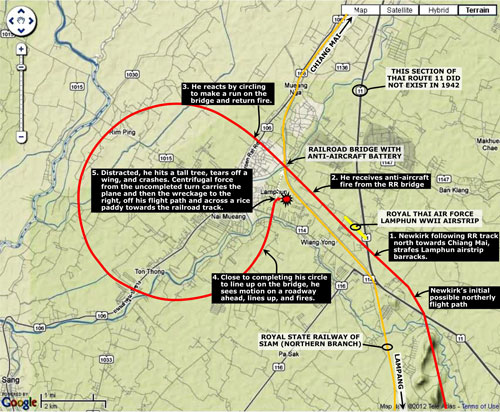
Sequence of events as reported by witnesses on the ground in 1994, during a visit by Flying Tigers Association members to the Newkirk crash site. Key points: The witnesses on the ground all recalled seeing a single aircraft coming from the southeast following the railway line north towards Chiang Mai. After the aircraft passed over them, an anti-aircraft (AA) gun on the southerly approach to the Ban Tha Lo three-span railway bridge (Google Maps link) next north on the railway line fired on the aircraft. The aircraft then circled counter-clockwise over the town to eventually again head northerly, nearly paralleling the railway, and fire on an oxcart on an adjacent road, killing driver and ox. Continuing northerly, at extremely low altitude, the aircraft clipped a tree on the road passing Wat Phra Yuen and crashed. Witnesses did not link the firing on the oxcart directly with the crash. The conclusion was that Newkirk’s aircraft had been damaged by the AA fire and, while losing altitude and searching for a place to land, Newkirk had hit a tree.5 Newkirk’s possible flight path per witnesses on the ground:6

Coordinates for the main crash site (ie, resting place for the fuselage (Google Maps link) were established as about N18°34.757 E99°01.247 (his grave (Google Maps link) at the edge of the paddy was at about N18°34.691 E99°01.191.)7
Comment: it is often suggested that Newkirk confused Lamphun with his assigned target of a similar name, Lampang, about 60 km further to the southwest: that confusion continues today amongst non-Thai speaking foreigners (but see “Additional Thoughts” below). There is no record of the map(s) used by Newkirk and his flight on that mission.
Details of the crash are discussed in more detail at:
Wat Phra Yuen
Jack Newkirk, the view from the ground (Jack Eisner) (offsite link)
Photo-map of the crash site (Jack Eisner) (offsite link)
Jack Newkirk, was he shot down? (Bob Bergin) (offsite link)
Additional thoughts:
If Newkirk was the only one to have witnessed the AA gun firing from the railway bridge area, and his plane had not been damaged, no one else in the flight could have realized that his apparent turn towards Chiang Mai reported in after-mission reports might have been to attack the AA gun at the bridge; with that gun neutralized, possibly he would have turned south again to head towards his assigned target, Lampang. His group faithfully followed Newkirk, but with his crash, Lawlor, who took over command of the mission, and not having seen the initial firing from the bridge, had no reason not to assume that Newkirk was returning to home base, so he continued north.
Only in 1994 did Flying Tiger veterans visiting Newkirk’s P-40 crash site learn of additional information from Thai observers on the ground. They concluded that Newkirk’s P-40 might have incurred substantial damage from the AA gun at the bridge and Newkirk, losing altitude, was looking for an area in which to land when he couldn’t clear a tree, hitting it and crashing. That, however, seems unlikely in that his counter-clockwise circle around Lamphun took him first over a vast area of rice paddy to the west of the town, visible in aerial photos of the era and suitable for an emergency landing:8
A melding of the crash versions into a cohesive whole might look like this:9
Afterword:
Newkirk’s remains were buried by locals at the edge of the rice paddy where he crashed. The wreckage was collected, and a few days later, a photo of the wreckage in front of the Lamphun police station appeared in a local newspaper.10 The Nationalist Chinese roundel, clearly visible in the wreckage, had been painted on all AVG P-40s, identifying them as part of Chiang Kai-shek’s military force:(Photo from Summary of Events, March 1942 in Facebook: ห้องวิจัยประวัติศาสตร์ [Historical Research Room]; found by Sakpinit Promthep.))

Boonserm Satrabhaya recalled that aircraft wreckage had been displayed in the front of Wattanothai Payap Girls School along Boonruangrit Road; but he could not say for sure that it was Newkirk’s P-40. That wreckage was later moved to the Railway Station where it displayed for some time; finally it was shipped off to Bangkok — presumably before the Allied raid that destroyed the station in Dec 1943.11 Whether true or not, the wreckage can be assumed to have eventually found its way into a Japanese scrap metal drive.12
Newkirk was credited with seven air-to-air victories during his time with the Flying Tigers.
After the war, Newkirk’s body was disinterred by a joint Thai-American military team and reburied in Saint James the Less Cemetery, Scarsdale, Westchester County, New York on 11 May 1949. Newkirk was awarded the Distinguished Flying Cross, posthumously, in 2007, following the 1991 official recognition of the Flying Tigers as veterans of World War II.13
References (listed chronologically by publication date):
• Ford, 1991:14
. . . Jack Newkirk and the other three Panda Bears set off for Thailand . . . They flew on instruments until they reached Chiang Mai about 7 AM . . . Newkirk tarried long enough to strafe the Chiang Mai railroad station . . . Flying on he found Lamphun but not the bombers he’d been sent to strafe, just some buildings that might have been warehouses or barracks. He laced them with incendiary bullets, then scouted some auxiliary airfields. At the third and largest field, the Panda Bears strafed more buildings after which Newkirk turned north with the apparent intention of joining the Adam & Eves back at Chiang Mai.
In his combat report, Hank Geselbracht told . . . “The next target we dove on were two vehicles on the road south of [Chiang Mai]. Newkirk dove and fired and as he cleared the target, I began to fire. I saw a flash of flames beyond the target and looked for Newkirk after my run. I realized he had crashed causing the flash. I pulled up and continued to the north on the way home.” Bus Keeton saw the same explosion, and like Geselbracht failed at first to understand its cause. “As I pulled up to the right,” he wrote, “I noticed a large flame of fire burst up on a field to the right of me. The fire spread along the field for a 100 or 150 yards. Thinking Jack and Gesel had set fire to some oil dumps and not seeing anything to shoot at, I proceeded to follow Lawlor.”
• Shores, et al, 1993:15
[A very misleading account of AVG activities on 24 Mar 1942, including the crash of Newkirk.]
• Umemoto, 2002:16
Entry for Newkirk (Umemoto, v 1, p 461) Item Japanese English translation Date 昭和17年03月24日 24 March 1942 Unit 2Sqn/AVG 2Sqn/AVG Casualty P-40B Curtiss P-40 Warhawk Pilot ジャツク•ニューカーク Jack Newkirk Location チェンマイ飛行場 Chiang Mai Airfield Shooter 対空砲火 Anti-aircraft fire Details 戦死 Killed in action Note that Umemoto placed the crash incorrectly in Chiang Mai, not Lamphun.
Umemoto comment (translated):17
◎ “Immortal Jack”, 64th Sentai humiliation, Chiang Mai air raid
On March 24, P-40s of the US AVG were dispatched from Kunming to strafe Japanese heavy bombers at Lampang Airfield in Thailand. . . . A Japanese anti-aircraft gun brought down the Squadron’s flight captain, “Immortal Jack” Newkirk of the “Panda Bears”, and he was killed in the crash.
• Bob Bergin, 2008:
A more detailed account about Jack Newkirk’s AVG service is Bob Bergin’s article, Meteoric Combat Career of a Flying Tiger (offsite link), on Historynet.
| First published on Internet | ||
| Numerous corrections; maps improved | ||
| Add copy para, change title, footer | ||
| Converted to WordPress by Ally Taylor | ||
| Updated, author major errors & typos corrected | ||
Last Updated on 26 February 2026
- This text on this page is largely based on Bob Bergin’s article, “Flying Tiger, Burning Bright“, Aviation History, July 2008, pp 24-31 (offsite link).[↩]
- Photo from Newkirk Genealogy, John Van Kuren “Scarsdale Jack” Newkirk (offsite link).[↩]
- Map extracted from Google Maps; annotations entered with Microsoft Publisher by author.[↩]
- See Lawlor‘s listing. The three were possibly: Lamphun Landing Ground, Ban Klang, Ban Thi[↩]
- A different group of local witnesses in 2009 basically verified the earlier group’s account with only minor variations. The conclusion, however, did differ: Newkirk’s aircraft had not been damaged by AA fire and he had circled the town to line up on the bridge to try to take out the AA gun. On his final leg he had mistaken the oxcart for an enemy vehicle, dove on it, and fired; then, misjudging his pullout, hit a tree, which brought the plane down.[↩]
- Composite of RAF aerial photos 02561.jpg thru 02565.jpg, dated 26 Mar 1944; manually assembled; annotated by author using Microsoft Publisher. GDAP, the source of the arial photos in this composite, asked that the following information be included regarding the aerial imagery shown: Williams-Hunt Aerial Photos Collection Original from the School of Oriental and African Studies (SOAS), University of London Digital Data from Center for Southeast Asia Studies (CSEAS), Kyoto University Digital Archive from Chulachomklao Royal Military Academy (CRMA), superimposed on an extract of a Bing map of Lamphun area.[↩]
- Coordinates from Google Earth Pro About three years later, 2Lt Thomas Ankrim in a P-51 would die in a similar collision with a tree on a strafing run near Tachileik, Burma, just north of Mae Sai, Thailand. (441207A[↩]
- See overlay directly above.[↩]
- Extract from Google Maps, annotated by author with Microsoft Publisher.[↩]
- reference needed[↩]
- Author to Edgar email trip report of 08:22 15 Sep 2009 [my ref:/02200 Chiang Mai City] Boonserm at one of our meetings introduced me to someone who claimed to have had Newkirk’s leather jacket and worn it for years, until it wore out, and he had thrown it away. [ref needed][↩]
- As described in ชีวิตของมาซาโอะ เชโตะ ผู้ถูกพ่อและญี่ปุ่นทอตทิ้ง เล่ม 1, แปลจาก : Seto Masao no Jinsel (ชีวิตของมาซาโอะ เชโตะ), แปลโดย : บ้ณทิต ประดิษฐานุวงษ์ [Seto, Masao, Life of Masao Seto, Book 1, p 160 [my ref: 03400 Boggett/Seto xlatn][↩]
- Wikipedia: Jack Newkirk (offsite link) [↩]
- Ford, Dan, Flying Tigers (Washington: Smithsonian, 1991, 2007), pp 243-244.[↩]
- Shores, Christopher and Brian Cull with Yasuho Izawa, Bloody Shambles, Vol Two (London: Grub Street, 1993), pp 356-357.[↩]
- 梅本弘 [Umemoto, Hiroshi], ビルマ航空戦・上 [Air War in Burma, Vol 1] (Tokyo: Dai Nippon, 2002)], p 461.[↩]
- Umemoto, ibid, pp 93-94. [↩]